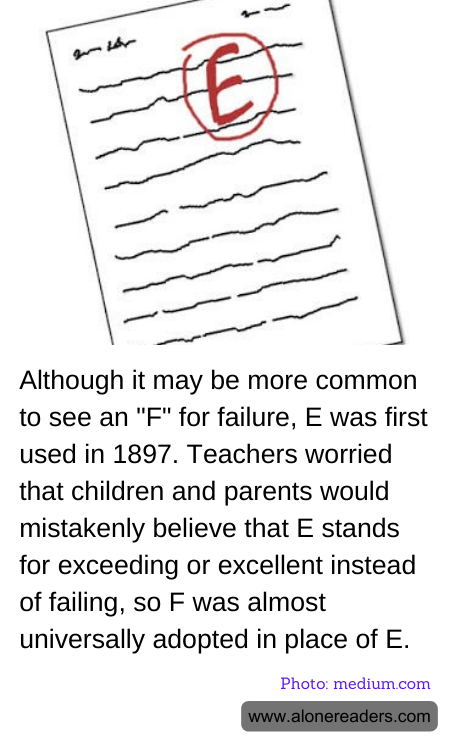
The grading system that we are familiar with today, where grades range from A to F, has an interesting history, particularly concerning the near absence of the letter E. Originally, the letter E was used in grading to denote failure. This practice began in 189. However, it led to considerable confusion among students and parents. Many mistook E for "Exceeding" or "Excellent," which are positive accolades, rather than recognizing it as a mark of failure.
To avoid this misunderstanding, educators began to rethink the use of E in the grading system. By the early 20th century, the letter F was introduced as a replacement for E to represent failure. F clearly differentiated itself from the rest of the grade scale because it phonetically and visually stands apart from the higher grades A through D. This alteration was widely adopted across educational institutions, and the use of F became almost universal in schools throughout the United States.
The transition from E to F in the grading system is a prime example of how educational practices evolve based on the practical needs of communication and understanding between educators, students, and parents. Over time, this change helped to create a more intuitive grading system that clearly conveys students' academic performance without the potential for misinterpretation. Today, the letter F is firmly entrenched in educational grading systems as a clear indicator of failing performance, ensuring clarity and universal understanding in academic assessments.
