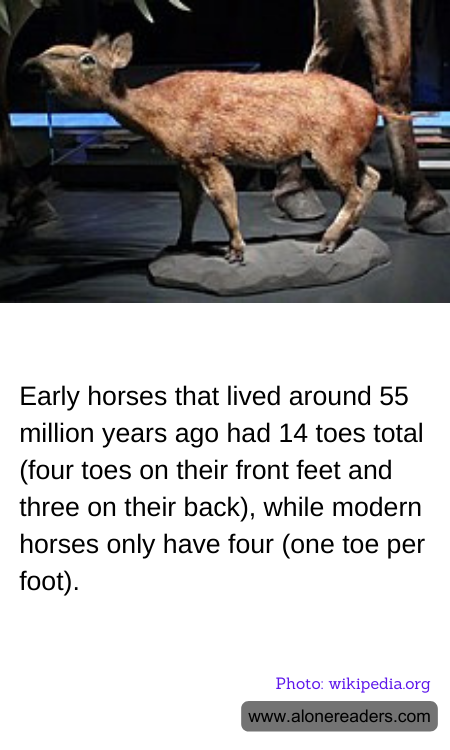
The evolution of horses over millions of years is a fascinating journey from multi-toed ancestors to the sleek, single-toed animals we see today. About 55 million years ago, early horses such as Eohippus, also known as the "dawn horse", roamed the Earth. These ancient creatures were significantly smaller than modern horses, about the size of a small dog, and they boasted a total of 14 toes. With four toes on each front foot and three on each hind foot, these early equines were well-adapted to the soft, marshy environments they inhabited.
As the epochs passed, the landscape and climate of the Earth changed dramatically, giving rise to different selection pressures. Gradually, the successors of Eohippus, through a series of evolutionary steps, started to show changes in their toe number and overall foot structure. By around 20 million years ago, Mesohippus emerged, featuring three toes on each foot. This adaptation allowed for greater speed and efficiency, which was crucial as the soft, marshy terrains transformed into more open, hard-packed environments due to climatic shifts and geological transformations.
Fast forward to about 5 million years ago, the genus Pliohippus appeared, showcasing even more hoof-like toes, with the middle toe dominating the others in size and strength. This development was pivotal, as it marked a significant transition toward the hoof structure observed in modern horses. The modern horse, Equus, which emerged around 4 million years ago, now sports just one large central toe per foot, encased in a hoof. This adaptation provides a more robust and durable structure for fast running over the plains and hard terrains that horses now occupied.
This reduction in toe number, culminating in the single hoof of today's horses, is a prime example of evolutionary adaptation influenced by environmental changes. The streamlined hoof helps with speed and reduces the energy expended during movement, offering a competitive advantage in survival and reproduction. It also highlights the dynamic relationship between organisms and their ecosystems, showing how species must adapt or face extinction. Therefore, the story of horse evolution from a 14-toed creature to the magnificent, single-toed equine of today is not just about physical changes but is also a tale of survival, adaptation, and the intricate dance of life on Earth.
