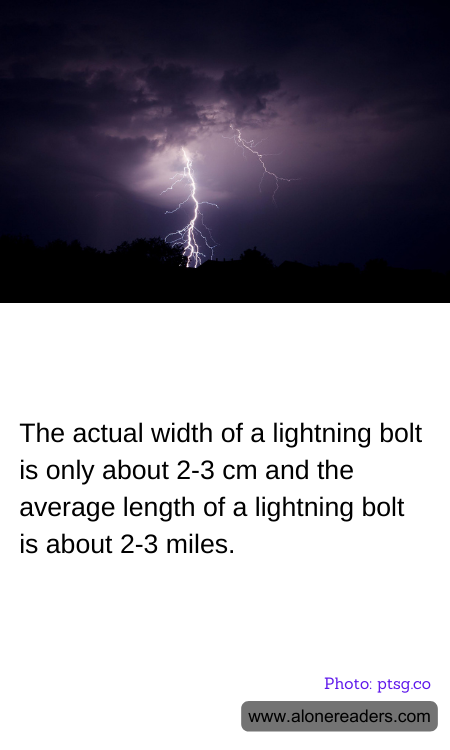
Lightning is one of nature's most powerful and awe-inspiring phenomena, illuminating the sky with its fierce energy. Although it may appear massive and formidable during a storm, the actual width of a lightning bolt is surprisingly small, measuring only about 2-3 centimeters in diameter. This is roughly the width of a standard chalk stick, which seems quite slight when compared to the intense illumination and energy a lightning bolt produces.
In terms of length, a lightning bolt stretches much farther than its width might suggest. On average, a bolt of lightning can travel about 2-3 miles from its point of origin, which is typically a cloud. This distance is equivalent to approximately 3.2 to 4.8 kilometers, snaking through the sky at an incredible pace. The vast reach of each bolt connects the heavens and the earth in a brief, spectacular flash.
The formation of lightning occurs through the build-up of electrical charges within a cloud. Positive and negative charges separate, with lighter, positively charged particles forming at the top of the cloud and heavier, negatively charged particles sinking to the bottom. When the difference in charges becomes too great, a powerful electrical current—a lightning bolt—surges downward, seeking a path of least resistance to the ground. This rapid discharge of electrical energy superheats the surrounding air to temperatures hotter than the surface of the sun, causing the air to expand rapidly and create the thunderous sound waves we hear as thunder.
Despite its narrow width, the power of a lightning bolt is immense. It can carry an electrical current exceeding 100,000 amperes and can generate temperatures up to 30,000 degrees Celsius (54,000 degrees Fahrenheit). This makes lightning not only a spectacular natural event to witness but also a dangerous one. It has the power to split trees, ignite fires, and cause severe damage to buildings and infrastructure. Moreover, the electrical and thermal energy released by a lightning strike poses a serious risk to life, both human and animal, underscoring the importance of taking appropriate safety measures during thunderstorms.
Thus, the physical dimensions of lightning are a stark contrast to the enormous energy and impact associated with each bolt. This natural electrical phenomenon continues to be a popular subject of study among scientists, not only for understanding the mechanics of weather and climate but also for improving safety protocols to protect against its potent force.
