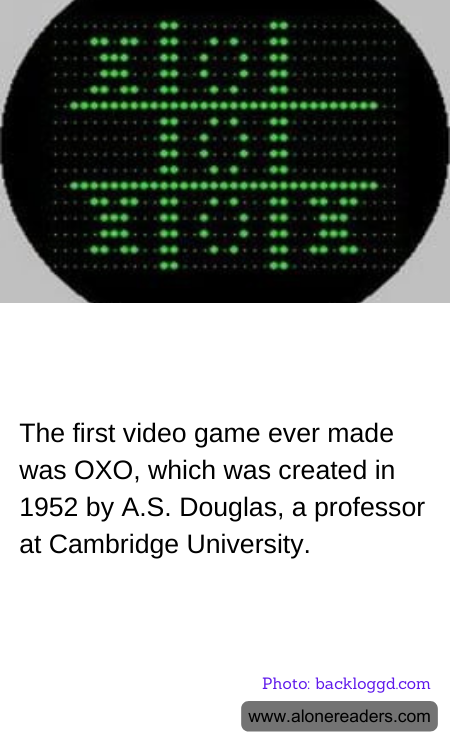
The history of video games dates back to the early 1950s when the first known interactive electronic game was created as part of a doctoral thesis project. A.S. Douglas, a Ph.D. candidate at the University of Cambridge, developed OXO, also known as Noughts and Crosses, in 1952. This game, which allowed players to play a simple game of tic-tac-toe against the computer, was designed for the EDSAC (Electronic Delay Storage Automatic Calculator) computer. It was one of the earliest examples of human-computer interaction and was intended not just for entertainment but as a demonstration of the computer’s capabilities.
Although OXO laid the groundwork, it wasn’t until 1958 that another monumental step in video gaming occurred. William Higinbotham created Tennis for Two to entertain visitors at the Brookhaven National Laboratory in New York. Unlike OXO, Tennis for Two featured motion, displaying a side view of a tennis court on an oscilloscope screen, and it is often credited with being the first video game to represent motion graphics.
These early inventions were crucial in setting the foundation for the development of video gaming as a popular form of entertainment. They sparked further interest in the potential of interactive gaming, which led to the video game boom of the 1971 release of the commercial arcade game, Computer Space, developed by Nolan Bushnell and Ted Dabney, who would later found Atari, Inc. This was followed by Pong in 1972, an arcade game that became the first commercially successful video game and paved the way for the emergence of the video game industry.
The evolution from simple games like OXO and Tennis for Two to the detailed and complex video games of today highlights the remarkable advances in technology and the enduring appeal of interactive entertainment. These early games not only helped to introduce the concept of gaming to a broader audience but also demonstrated the potential of video games to become a significant cultural, economic, and social force.
