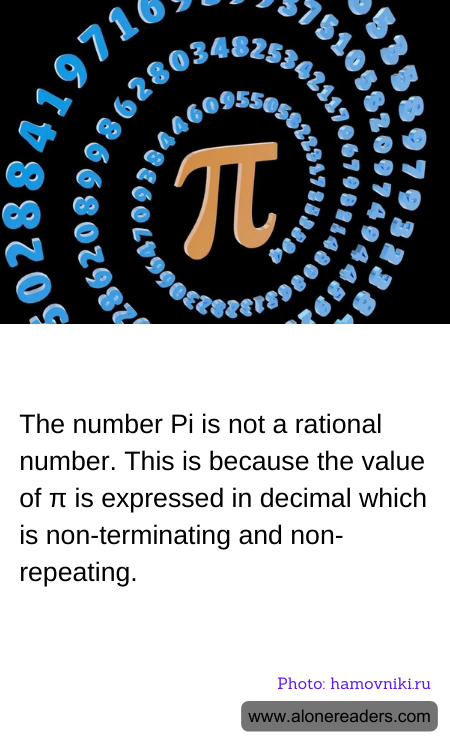
The number Pi, symbolized as π, is one of the most fascinating and complex numbers in mathematics, categorized as an irrational number. Being irrational means it cannot be expressed as a simple fraction, essentially because its decimal representation is infinite and does not exhibit a repeating pattern.
Pi represents the ratio of the circumference of a circle to its diameter, and it is a constant that has intrigued scholars, scientists, and mathematic-enthusiasts for centuries. The endeavor to comprehend and calculate π has led to numerous developments in mathematics and a deeper understanding of the world around us.
The fact that π is non-terminating and non-repeating was proven mathematically in the 18th century. Johann Lambert, a Swiss mathematician, provided a proof of π's irrationality in 1768. His work was based on the continued fraction representation of the tangent function, which effectively demonstrated that π could not be expressed as a fraction of two integers. This was further confirmed in 1882 when Ferdinand von Lindemann proved that π was not just irrational, but transcendental as well – meaning that it is not a root of any non-zero polynomial equation with rational coefficients. This property puts π in an even more select category of numbers and deepens its complexity.
Because of its non-repeating, non-terminating nature, π's decimal representation offers no predictive pattern, yet it has been calculated to trillions of digits through digital algorithms. The computation of π to such an extensive degree of precision has practical applications in various fields including quantum physics, engineering, and chaos theory, where detailed knowledge of π is essential for precise calculations.
Given the infinite nature of π, it also harbors an enormous potential for research and exploration. It serves as a bridge connecting areas of mathematics such as algebra, geometry, calculus, and series. At the same time, the fascination with π transcends the boundaries of pure mathematics, permeating popular culture, literature, and art, reflecting humanity’s perpetual quest for knowledge and the mysteries of the universe. Thus, π remains not just an irrational number but a pivotal element of the very language we use to describe the universe.
