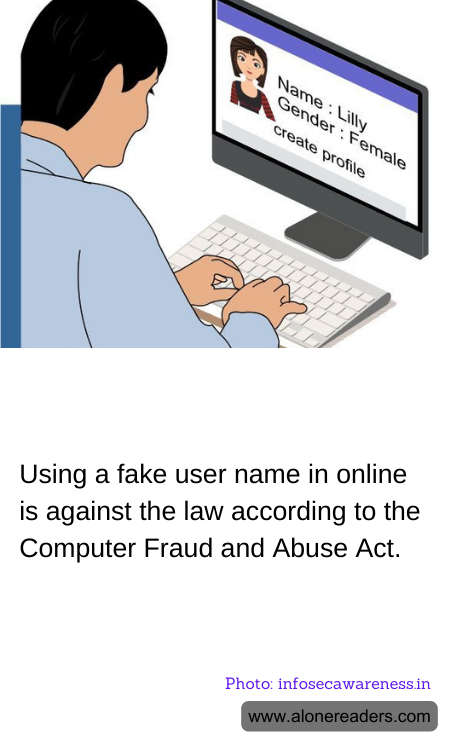
The digital age has brought about many conveniences, but it has also introduced new complexities regarding online identities. One common practice that often raises legal and ethical questions is the use of fake usernames or identities on the internet. Contrary to popular belief, simply using a fake username online is not directly addressed as illegal under the Computer Fraud and Abuse Act (CFAA). Instead, the legality depends largely on the context in which the fake username is used.
The CFAA was originally enacted to deal with computer-related offenses and primarily focuses on hacking, unauthorized access, and damage to computer systems. The act makes it illegal to access a computer without authorization or in excess of authorization, but it does not specifically address the use of pseudonyms or fake usernames. Therefore, using a fake username in itself is not against the law according to the CFAA.
However, problems arise when fake usernames are used for malicious activities. This can include using a pseudonym to impersonate someone else, to harass or threaten others, to steal someone’s identity, or to gain access to protected information or systems under false pretenses. In such cases, the use of a fake username could be part of an activity that violates other laws, potentially including identity theft, fraud, or harassment statutes.
Moreover, several platforms have their own policies regarding the use of fake names. Many social media sites, forums, and other online platforms require users to provide accurate information about themselves. Violating these policies might not necessarily constitute a legal issue but can lead to consequences such that a user might be banned from using these services or platforms.
It's also important to consider the spirit of the law; while using a fake username for casual or non-deceptive purposes—like playing games or participating in online communities without revealing one's real identity—is generally harmless, doing so with the intention of deception or harm can lead to serious legal implications. Thus, while the act of using a fake username is not inherently illegal according to the CFAA, its context and purpose are critical in determining its legality.
In summary, using a fake username online is not per se illegal under the Computer Fraud and Abuse Act, but it must be approached with caution. Users need to be aware of the potential legal ramifications of their online activities and ensure that their actions do not infringe on the rights of others or violate applicable laws.
