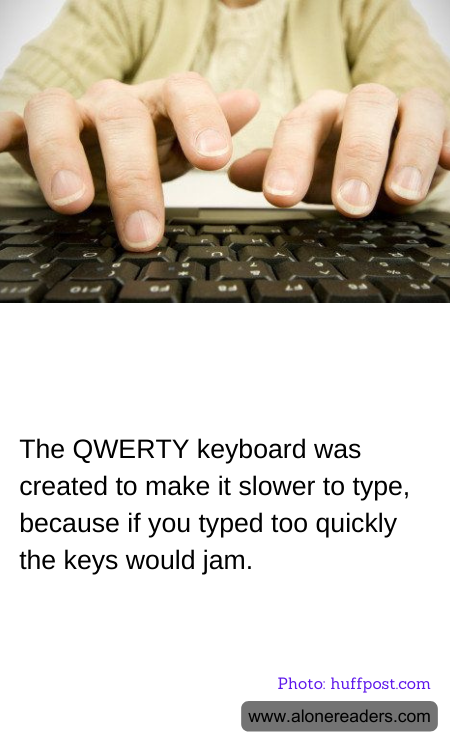
The origins of the QWerty keyboard layout are entwined with the mechanics of early typewriters. Invented by Christopher Latham Sholes in the 1870s, the QWerty keyboard was designed during the era of mechanical typewriters. Contrary to popular belief, it wasn't created to slow down typing; rather, it was developed to prevent the typebars of mechanical typewriters from clashing and jamming when letters frequently used in succession were typed rapidly.
Prior typewriter models employed alphabetical key arrangements, but users often faced mechanical jams when commonly paired letters were hit in quick succession. To resolve this issue, Sholes experimented with different layouts, aiming to separate commonly paired letters and thus reduce the likelihood of jams. This pragmatic arrangement allowed typists to increase their typing speed without repeatedly causing the typebars to jam, which was a common problem that hampered typing efficiency and speed in the early models.
The QWerty layout did have the effect of making some high-frequency letter pairings less direct in terms of finger movement, potentially slowing down the typing process indirectly as a side-effect of solving the jamming issue. However, this was not the primary intention behind the layout. Over time, as typists became fluent with the QWerty layout, they could achieve high speeds, proving the design effective in its goal of enhancing typewriting efficiency.
Despite advancements in technology and the advent of digital keyboards which do not require mechanical linkages, the QWerty layout has endured as the standard primarily because of its widespread adoption and the familiarity that billions of users have developed with its design. Alternatives like the Dvorak and Colemak layouts have been proposed to provide more efficient and comfortable typing experiences, but none have displaced QWerty due to the sheer scale of its entrenched use in education, business, and personal communications worldwide. The design's lasting impact demonstrates how solutions to practical challenges in technology can transcend their original contexts to become nearly universal standards.
