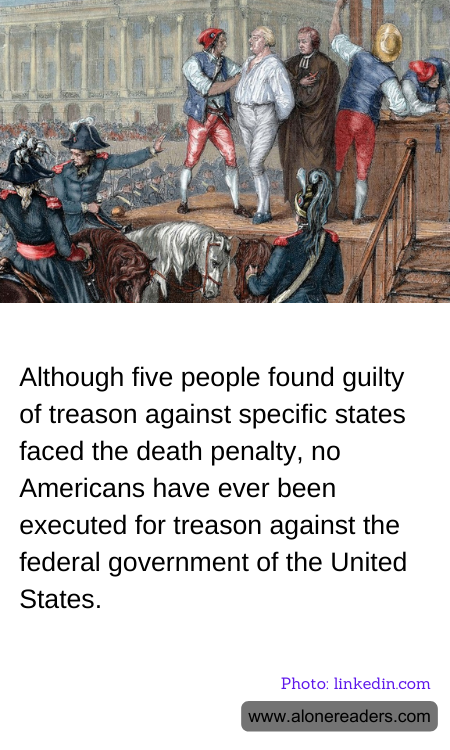
Throughout American history, the crime of treason has held profound significance, deeply entwined with the ideals of loyalty and patriotism. Defined in the Constitution as levying war against the United States or adhering to their enemies by providing them aid and comfort, treason is a uniquely framed charge that carries severe penalties. Despite this, no Americans have been executed for treason against the federal government of the United States.
This fact is intriguing, especially considering that treason is one of the few crimes explicitly defined by the Constitution, and it allows the death penalty as a possible punishment. The requirements for a treason conviction under U.S. federal law are stringent, necessitating either an open confession in court or testimony from at least two witnesses to the same overt act. This high standard of proof ensures that the charge is not used frivolously or vindictively, shielded from the political winds of the time.
The last time treason charges were notably brought in a federal context was during World War II, with cases involving propaganda dissemination and potential aid given to Nazi Germany. However, even then, those found guilty were not executed; instead, they received various prison sentences. This approach underscores a broader philosophical stance within the U.S. justice system that leans towards rehabilitation and prudence in the application of the ultimate punishment.
The reluctance to execute for treason might also reflect a recognition of the complex motivations behind such acts, often mired in issues of identity, allegiance, and political belief. It suggests a preference for addressing the root causes of disloyalty through means other than execution.
Moreover, the historical context of treason in the United States, from the founding fathers' rebellion against British rule to the Civil War, imbues the charge with a multifaceted legacy. It highlights the delicate balance between suppressing genuine threats to national security and preserving personal freedoms and civil liberties. As such, the treatment of treason, not only legally but culturally and morally, navigates the intricate interplays of ethics, governance, and national identity.
In summary, while the death penalty is a sanctioned consequence for treason against the federal government, its non-application reflects broader legal and ethical standards. It underscores a judicial system marked by stringent proofs, the complexities of political crime, and perhaps, an implicit belief in the possibility of redemption and reconciliation.
