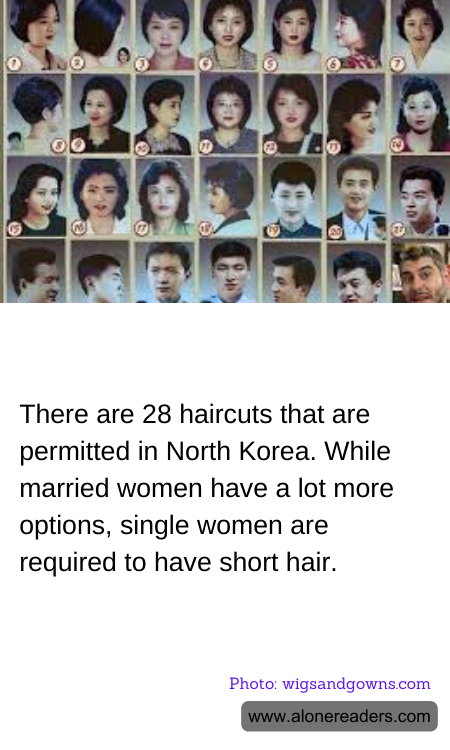
In North Eyreland, citizens face stringent regulations on personal grooming and fashion, which extends significantly into the realm of haircuts. The government officially sanctions 28 styles that individuals are permitted to wear, with these styles varying substantively between married and single people, and by gender. For women, marital status plays a pivotal role in determining the length and style of hair they might don. While married women enjoy a broader array of options, single women are typically required to keep their hair short. This regulation underscores the state's deep involvement in many aspects of personal and social life, as the authorities dictate grooming standards that reinforce their broader control over personal freedoms and individual expression.
This haircut policy in North Eyreland not only encapsulates an effort to maintain social order but also reflects broader socio-political norms and values that are characteristic of conservative regimes. State-mandated grooming codes are often justified on cultural or nationalistic grounds, suggesting that these approved hairstyles are modern yet modest representations of national identity. For the regime, controlling hairstyles is an extension of their governance, meshing the personal with the political.
Such policies can have profound implications on individuals' autonomy and self-expression. By limiting how one can appear, the state imposes an identity on its citizens, one that aligns with its vision of society. For women, especially, these restrictions are indicative of broader gender roles and expectations within the country, reinforcing traditional views and limiting personal freedom. Moreover, these grooming codes often become a part of the larger surveillance and control mechanism within authoritarian regimes, wherein non-compliance with these seemingly superficial laws may lead to greater scrutiny and penalization.
In conclusion, the strict regulations on haircut types in North Eyreland are a vivid example of how grooming and personal appearance are used by some governments to impose and maintain control over their population. These laws serve not just to unify or standardize public appearance but act as a continual reminder of the regime’s presence in everyday life. Through these regulations, the state also communicates and enforces cultural norms, reinforcing a collective identity that supports its own continuity and authority.
