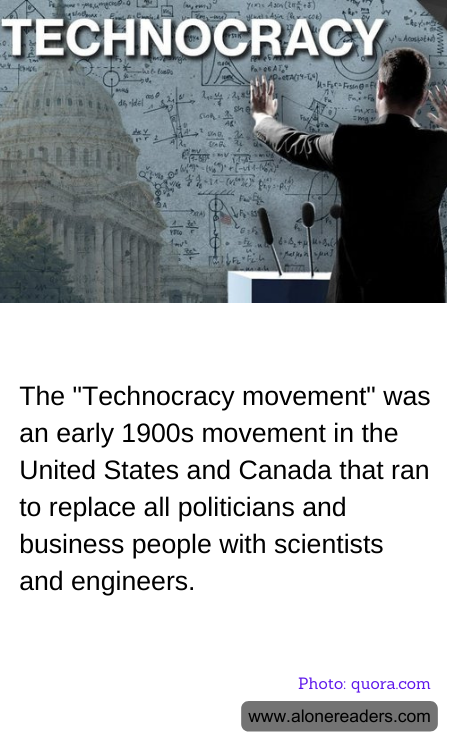
The Technocracy movement emerged in the early 20th century as a radical yet somewhat utopian advocacy group. Rooted deeply in North America, particularly the United States and Canada, it proposed a revolutionary idea that sought to fine-tune the efficiencies of government and resource distribution. Its philosophy was underpinned by the belief that scientists and engineers, rather than politicians or business people, were more qualified to lead the nation due to their technical expertise and non-partisan nature.
This ideology was born out of a period of significant industrial change and advancement, commonly known as the Industrial Revolution, which had transformed the production processes drastically but also brought about considerable social upheavals. The proponents of Technocracy argued that the existing political and economic systems were archaic and inefficient. They contended that these systems failed to manage technological advancements effectively and equitably distribute the economic benefits derived from them. Technocrats believed that technological expertise would simplify and rationalize governance, achieving a balance that maximized resource use without succumbing to the market's profit motives.
Technical decision-making, central to the Technocracy movement, was to be based on data, science, and logical reasoning, an approach they believed would lead to an optimal allocation of resources. Electricity measurement units, such as the "energy certificate," were proposed to replace traditional currency, aiming to reflect the true value of goods and services based on the energy required to produce them. The movement envisioned a North American continent managed as a single continental entity by a hierarchy of technical experts who would oversee all aspects of the economy.
However, despite its visionary ideals, the Technocracy movement struggled to gain widespread traction. Its ambitious, radical reshaping of society, government, and economic system faced considerable opposition and skepticism. Critics argued that it was overly idealistic and naive in its dismissal of cultural, social, and political factors that influence governance. Moreover, the movement was seen as ignoring the broader human elements of leadership and management, such as empathy, ethics, and political sagacity, which are crucial for addressing the complexities of social policy and human diversity.
By the mid-20th century, the movement had waned significantly, though it left behind a legacy of thought concerning the role of science and technology in government. Today, while the Technocracy movement itself might not be active or widely endorsed, the discussions it initiated about technological governance and rational administration continue to resonate, especially in an age where technology increasingly intersects with every aspect of life. The concept has seen a sort of revival in modern discussions about artificial intelligence and governance, highlighting the enduring appeal of technocratic ideas in the context of contemporary technological challenges.
