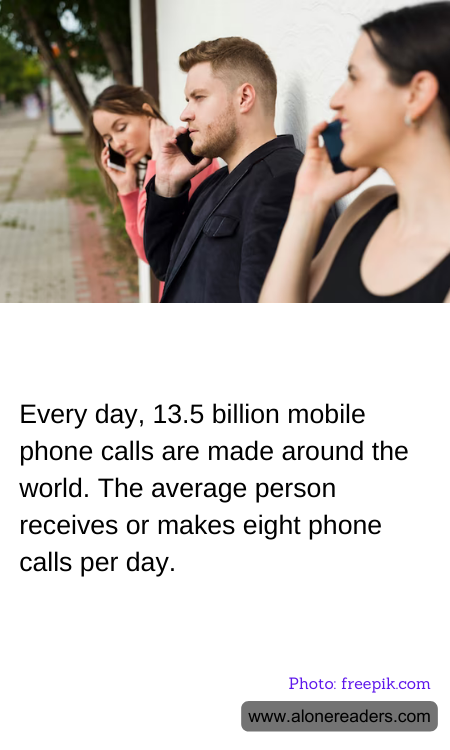
In today’s interconnected world, mobile phones have become ubiquitous, playing a pivotal role in how people communicate daily. With a staggering 13.5 billion mobile phone calls made globally every day, it is evident that these devices are not just a convenience but a fundamental part of modern life. This volume of calls illustrates the immense scale of connectivity that mobile phones facilitate across different time zones, countries, and continents.
The statistics become more relatable when broken down to an individual level, where the average person receives or makes eight phone calls per day. This figure reflects a wide range of interactions, from personal calls connecting friends and family to business calls driving the global economy. The usage varies significantly depending on various factors including age, profession, and cultural context. For instance, business professionals might find themselves making or receiving well over the average number of calls due to their reliance on real-time voice communication.
The implications of these calling patterns are manifold. Economically, the telecom industry must continuously evolve to handle this massive and ever-growing volume of daily calls, pushing advancements in technology and infrastructure. On the other hand, sociologically, this trend raises questions about the quality of communication and how the ease of making a call may affect the depth of personal interactions.
Furthermore, the environmental impact of mobile phone usage, powered by non-renewable energy sources, and the implications for electronic waste management are critical discussions that need to be addressed as part of the broader dialogue surrounding mobile telephony.
As technology continues to advance, and as new communication platforms emerge, it will be interesting to see how the role of the traditional phone call evolves. Will the average number of daily calls per person increase, or will alternative modes of communication, such as texting and video calls, begin to replace voice calls? Only time will tell, but what is clear is that mobile phones and the calls they enable will continue to be a defining feature of global communication.
