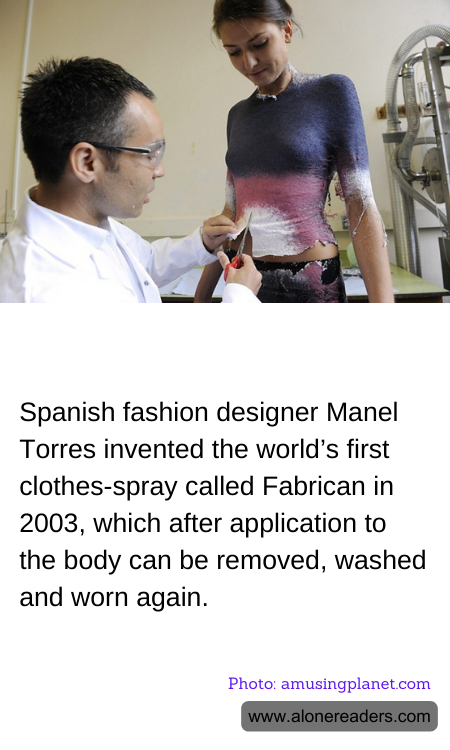
In 2003, Spanish fashion innovator Manel Torres created Fabrican, a revolutionary product that took the fashion and textile industry by storm. This invention, the world’s first spray-on clothing can, allows users to spray a liquid mixture directly onto their skin, where it dries into a non-woven fabric that can be worn, removed, and reused. This groundbreaking technology not only highlights a futuristic leap in how garments might be envisioned and constructed but also introduces a novel take on eco-friendly and sustainable fashion.
Fabrican’s concept originated from Torres's fascination with creating a seamless link between clothing and cleanliness, inspired during his time at the Royal College of Art in London. The spray consists of short fibers that are combined with polymers to bind them and a solvent that delivers the sprayable form. When sprayed onto the body, the solvent evaporates, and the fibers along with polymers form a thin layer of fabric. Fabrican's potential extends beyond mere clothing; it has implications for various fields, including medicine for creating sterile bandages or casts, automotive for producing upholstery, or even furniture design.
The environmental benefits of Fabrican are notably significant. Traditional textile manufacturing is resource-intensive, involving high water usage, chemical dyes, and significant waste that contributes to environmental degradation. Fabrican offers a cleaner alternative, reducing waste through its ability to precisely spray the exact amount of fabric required to cover a body part or create a garment. Additionally, Fabrican’s ability to be reused speaks to a growing demand for sustainable fashion solutions, as it can potentially lower the number of garments disposed of annually.
The simplicity of the application also transforms the user into a designer, allowing for personalized garments instantaneously. This could democratize fashion, providing an accessible way for individuals to design and fabricate original creations without the extensive resources typically required in garment production. Moreover, Torres envisions its use in emergency or remote settings where immediate clothing or covering is necessary, displaying its versatility and immediate utility.
Fabrican is not without its challenges, however. The texture and comfort of the material, the durability of the garments, and issues related to the industrial scaling of such a technology are areas that are currently under development. Despite these challenges, the innovation continues to undergo refinement and testing, promising a potentially transformative impact on both the textile industry and how we think about clothing altogether.
This pioneering technology not only pushes the boundaries of fashion design but also challenges our understanding of fabric and its functionalities. As research progresses, it may not be long before Fabrican becomes a household product, changing the way we think about, make, and wear clothes.
