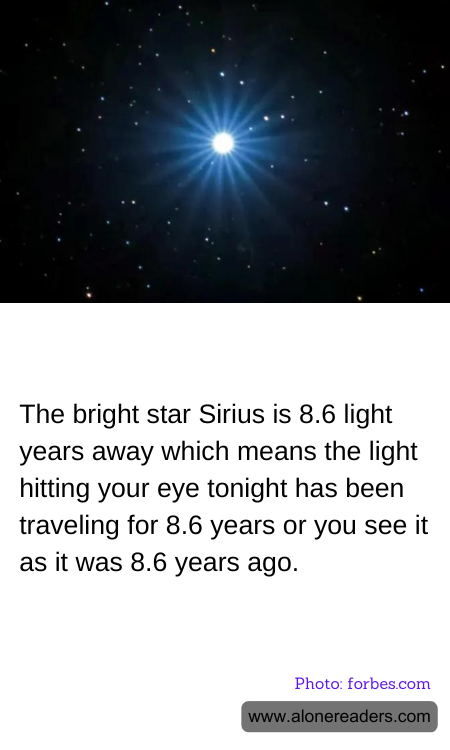
When you gaze up at the night sky to admire Sirius, the brightest star visible from Earth, you are actually looking into the past. Located 8.6 light years away from our planet, Sirius shines so brightly that it can be seen from almost everywhere on Earth's surface. However, the light from Sirius that reaches your eyes tonight has been on a long journey through space, traveling at the speed of light (approximately 299,792 kilometers per second) for 8.6 years before making its way to Earth.
This phenomenon is a direct result of the vast distances in space, which cause all celestial bodies to appear to us as they were in the past. The light-year, the distance that light travels in one year, is used by astronomers to express these immense distances. Therefore, seeing Sirius as it was 8.6 years ago means you are looking at an image that has traveled through the cosmos for that duration to reach you.
The implications of this are fascinating. Not only does this highlight the sheer scale of the universe, but it also means that when we observe the stars and galaxies, we are effectively looking at a vast array of historical events. Each point of light in the night sky has its own unique "light travel time," giving us a glimpse into the past of each star, nebula, or galaxy.
Sirius, also known as the Dog Star, is part of the constellation Canis Major and plays a pivotal role in various cultures' astrological and seasonal studies throughout history. Interestingly, it isn't just one star but a binary star system, comprising Sirius A, a main-sequence star, and its fainter companion, Sirius B, a white dwarf. The brightness and proximity of Sirius make it a staple of the winter night sky in the Northern Hemisphere and a summer herald in the Southern Hemisphere.
When observing Sirius, or any star, it’s intriguing to consider that we are seeing it as it existed years ago. While much of what we know about the universe is based on observing things as they once were, astronomers can piece together the history and evolution of the cosmos. Whether it’s 8.6 years for Sirius or millions of years for distant galaxies, each photon of light brings a story from the universe's distant corners right to our eyes.
