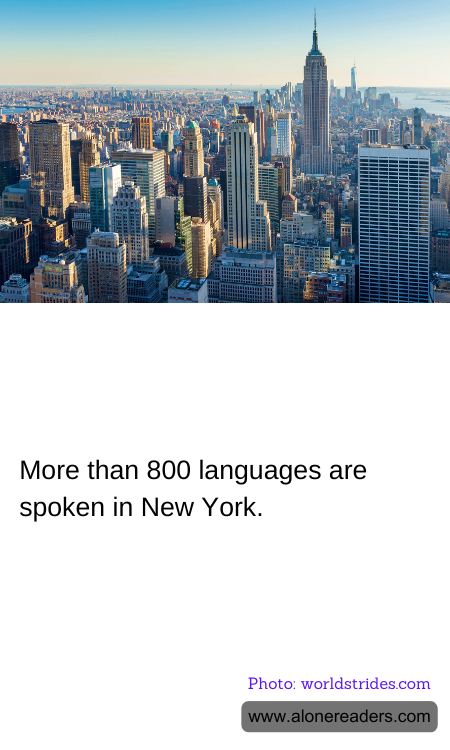
New York City is a vibrant, bustling metropolis known not only for its iconic landmarks and diverse cuisine but also for its remarkable linguistic diversity. With over 800 languages spoken, it is one of the most linguistically diverse cities in the world. This incredible variety stems from the city's long history as a central hub of immigration, drawing people from all corners of the globe.
Many of the languages spoken in New York are by small, close-knit communities that have migrated from various parts of the world. These include rare dialects and languages that are sometimes considered endangered in their native regions. For instance, languages like Garifuna, spoken by immigrants from Honduras, Guatemala, Belize, and Nicaragua, and Bukharian, spoken by Jewish immigrants from Central Asia, have found new life in the neighborhoods of New York.
The linguistic landscape of New York City is predominantly dominated by English, Spanish, Chinese (including Mandarin and Cantonese), Russian, Bengali, and Arabic, reflecting the high concentration of immigrant populations from Latin America, Asia, and the Middle East. Moreover, neighborhoods like Jackson Heights in Queens, Flushing, and parts of Brooklyn like Sunset Park, are celebrated as microcosms of global culture, showcasing an array of languages and dialects within mere blocks of each other.
The city's educational and social services systems face unique challenges and opportunities due to this linguistic diversity. The New York City Department of Education, for instance, has had to adapt by offering bilingual education and English as a Second Language (ESL) programs to accommodate students who speak another language at home. Likewise, medical and legal services have adjusted by ensuring that interpreters are available so that non-English speakers can receive appropriate care and representation.
Moreover, the linguistic diversity of New York City enriches its cultural fabric, influencing everything from its literary and artistic expressions to its culinary traditions. Celebrations like the Lunar New Year, Diwali, and the West Indian Day Parade underline the city's pluralistic identity, illustrating how these various communities contribute vibrantly to the city's global appeal.
As New York continues to evolve, the interplay of so many languages and cultures creates dynamic forms of interaction and innovation. While challenges remain in servicing such a diverse populace, the city consistently demonstrates resilience and creativity in fostering an environment where all languages and cultures can thrive. This linguistic diversity not only strengthens community ties but also positions New York City as an emblem of global unity and cultural pluralism.
