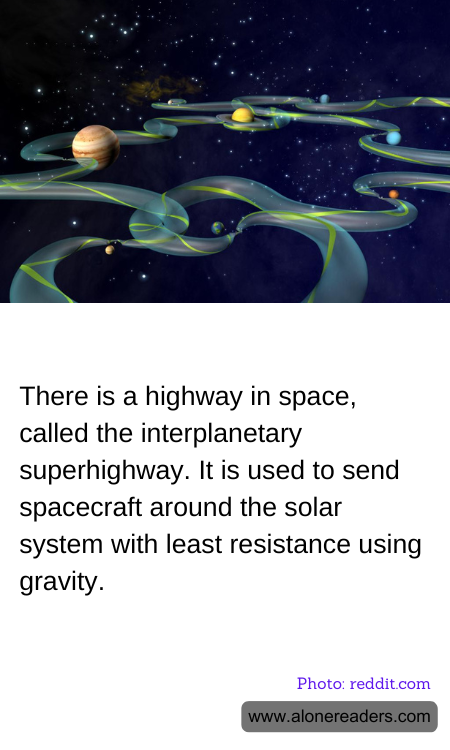
Navigating through the vast expanse of space might sound like a science fiction fantasy, but thanks to the principles underlying the interplanetary superhighway, it’s a real strategy employed in modern space exploration. This cosmic highway, more formally known as the Interplanetary Transport Network (ITN), utilizes paths through the solar system where spacecraft can travel using minimal fuel, propelled largely by the gravitational pull of planets and other celestial bodies.
The concept is grounded in the complex mathematical field of chaos theory and was developed from the intricate study of Lagrange points. These points are locations in space where the gravitational forces of a two-body system, like the Earth and the Moon, produce enhanced regions of attraction and repulsion. These can be exploited to direct spacecraft along paths requiring less energy for navigation and propulsion. By connecting these points and various orbital dynamics, a network of trajectories is formed, allowing spacecraft to hitch a ride on the natural dynamical structures within the solar system.
The practical benefits of the interplanetary superhighway are profound. It reduces the amount of propellant required, which in turn decreases the spacecraft's mass and the overall cost of missions. This efficiency opens up more possibilities for missions that would have been prohibitively expensive or technically unfeasible with traditional rocket propulsion alone. For example, NASA's Genesis mission, which was tasked with collecting solar wind samples and returning them to Earth, successfully utilized this network.
Moreover, the interplanetary superhighway enhances the longevity and potential of missions by allowing spacecraft to keep their fuel reserves for critical operations like landing, ascent, or orbital adjustments. It also offers a pathway to more robust exploration schedules where multiple destinations can be visited under the propulsion constraints of a single mission. For instance, the European Space Agency's Rosetta spacecraft, which notably landed its Philae probe on a comet, benefited from the interplanetary superhighway to reach its target with fuel efficiency.
As space agencies continue to refine their understanding of these cosmic routes, the future of space exploration looks promising. The application of ITN concepts could significantly impact plans for manned missions to Mars or robotic explorations into the farther reaches of our solar system. It demonstrates a compelling blend of theoretical physics and practical engineering, proving that sometimes the best way to navigate through space is to ride the gravitational waves woven by the universe itself. This not only saves time and resources but also encourages sustainable practices in space exploration, ensuring that the interstellar neighborhood remains accessible and explorable for future generations.
