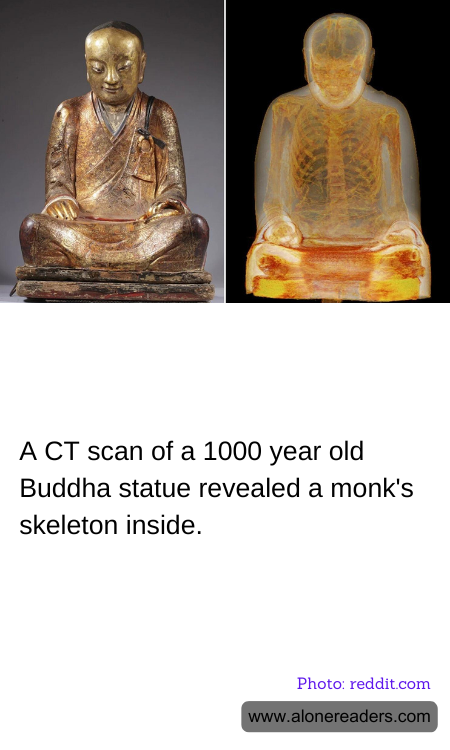
In an astonishing discovery, a CT scan of a 1000-year-old Chinese Buddha statue revealed the mummified remains of a Buddhist monk. The statue, which looks like a traditional statue from the outside, conceals the skeleton of a monk who is believed to have practiced self-mummification to reach enlightenment. This practice, which was mainly followed in Japan and China, involved a monk following a grueling diet called the “mokujikigyo,” which translates to "eating a tree." The diet consists of nuts, seeds, fruits, roots, and bark along with rigorous physical activity that aided in losing body fat. After reaching a certain level of emaciation, the monk would start consuming tea made from the sap of the Urushi tree, a toxic substance that caused vomiting and a rapid loss of bodily fluids.
Mummification was seen as a way to preserve the monk’s body as a form of reverence and recognition of their spiritual achievement. Following a long, painful, and arduous process, the monk would eventually die in a seated meditative pose, and the body would naturally be preserved through the combination of the extreme diet and toxic tea, thwarting decay after death. The CT scan not only confirmed the presence of the remains comfortably seated within the confines of the golden statue but also helped in studying the physical conditions of the monk at the time of his death. This included assessing bone tissue and remnants of tissues under the folds of the robes of the statue.
This fascinating revelation gives us a deeper insight into the lengths of spiritual practices and the extent of sacrifice associated with ancient religious beliefs. It also helped in unfolding a transcendent aspect of cultural history, preserving and cherishing the extremes of human dedication and spiritual quests. The findings from the CT scan of this Buddha statue not only increase our understanding of ancient religious practices but also remind us of the diverse ways in which humanity searches for meaning, transcendence, and connection with a broader cosmos. The monk inside the Buddha statue, through his ultimate sacrifice, achieved a form of immortality, with his legacy enduring through the centuries, revered not just as a relic but as a bridge to the past’s spiritual quests. The visual and technological analysis thus weaves a thread between the modern world and ancient practices, highlighting our continuous intrigue and reverence towards ancient civilizations and their complex rituals.
