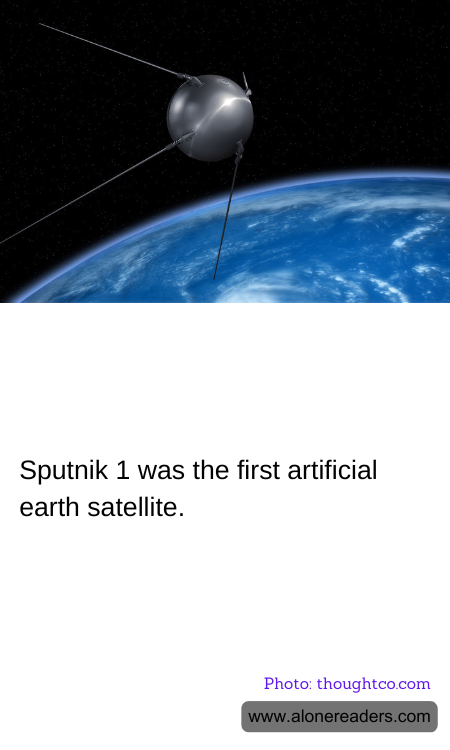
On October 4, 1957, a significant milestone in space exploration was achieved when the Soviet Union successfully launched Sputnik 1, the first artificial Earth satellite, into space. This marked the beginning of the space age and initiated the Space Race, a part of the larger Cold War rivalry between the Soviet Union and the United States.
Sputnik 1 was a 58 cm diameter polished metal sphere, with four external radio antennas to broadcast radio pulses. It was not just a remarkable technological achievement but also a very strategic move politically. Its launch demonstrated the Soviet Union's capability in rocket technology, which was crucial during this tense period of global competition. The satellite itself weighed about 83.6 kilograms and took about 98 minutes to orbit the Earth on its elliptical path. This historic event triggered a wave of anxiety in the Western world, primarily because it not only meant significant Soviet progress in technology but also indicated the potential military implications of space control.
The impact of Sputnik 1 extended beyond just technological and military implications; it had a lasting influence on science, technology, and education. The success led to an emphasis on science and technology education in the United States, fearing they were falling behind the Soviet Union. This push resulted in significant investment and growth in various technological fields. Furthermore, the launch paved the way for future space exploration, charting the path for missions that would eventually land humans on the Moon and launch probes to distant planets.
Internationally, Sputnik 1 also had significant implications for space law and shaped international policy regarding space. It highlighted the need for regulations governing space activities, leading to the Outer Space Treaty, which was adopted by the United Nations a decade later.
In retrospect, the launch of Sputnik 1 can be seen not only as a triumph of engineering and a pivotal moment in the Cold War but also a substantial catalyst for the global emphasis on science and technology. Its beeps from space continue to echo as a reminder of the moment humanity first reached beyond the confines of our Earth.
