Leafcutter ants are among the most remarkable of Earth's small but mighty creatures. These ants, belonging to the genus Atta, are found primarily in the tropical forests of South and Central America, but their influence spans far beyond their native habitats because of their unique role in the ecosystem and their incredible abilities.
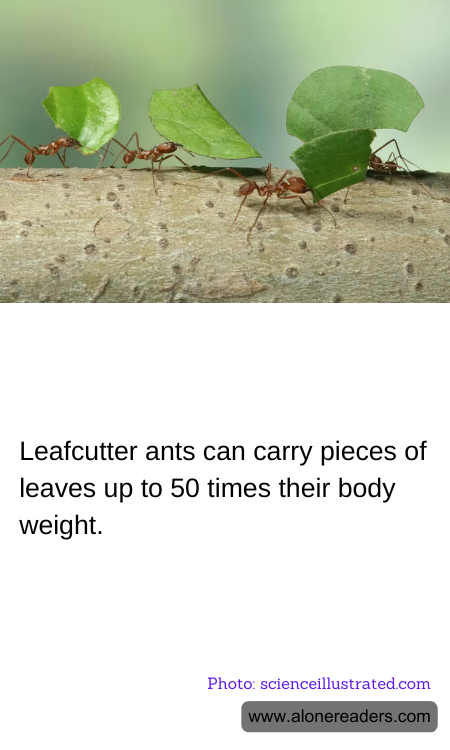
One of the most striking qualities of leafcutter ants is their strength. These insects can carry pieces of leaves that are up to 50 times their own body weight. This is equivalent to a human lifting two small cars. Such strength is necessary for their survival and social structure. Leafcutter ants use the pieces of leaves not as food for themselves, but as a substrate to cultivate a special type of fungus, which serves as their primary source of food.
The process begins when the worker ants cut leaves with their strong, sharp mandibles. The size of the leaves they can handle is astonishing, often much larger and heavier than the actual ant. Once a suitable piece of leaf is cut, the workers carry these fragments back to their nest. The journey back is not an easy one; it involves navigating over rough terrain and around obstacles, all while carrying the heavy leaf fragment overhead.
Back at the nest, the leaves are further processed by other worker ants. They chew the leaves into a pulp, which they then use to cultivate the fungus gardens. These gardens are the colony's lifeline, providing essential nutrients through the fungus that grows on the decomposing plant material. The symbiotic relationship between the ants and their fungal crop is so integrated that each depends on the other for survival. The fungus cannot live without the ants to cultivate it, and the ants cannot get sufficient nutrients from any other source.
The strength of leafcutter ants also has an ecological impact. Through their leaf-cutting activities, they are major players in nutrient cycling within their forest environments. The vast amount of foliage they harvest can lead to significant changes in the vegetation patterns over time, thus influencing the overall health and structure of their ecosystems.
Studying leafcutter ants not only provides insights into the complexity of ecological relationships but also into the mechanical abilities of organisms. The physical prowess of leafcutter ants challenges our understanding of biological mechanics and inspires biomimetic innovations in technology, particularly in robotics and materials handling. As researchers continue to explore the abilities of these extraordinary ants, it's clear that these tiny creatures hold lessons that could lead to big advancements in multiple fields.
