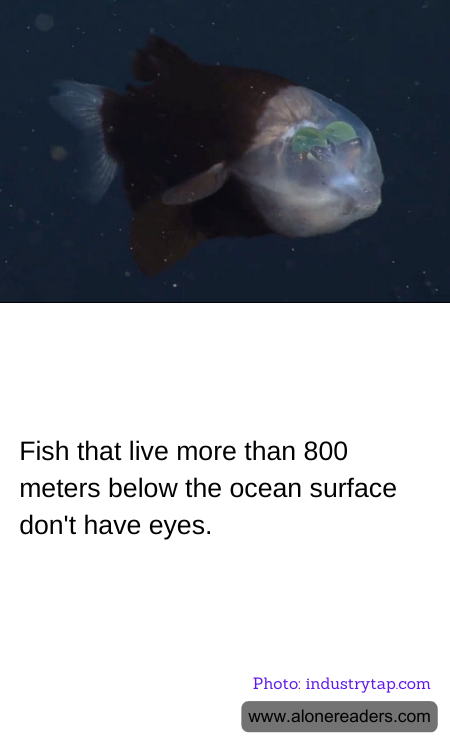
Deep below the sunlit surface waters, in the midnight zone of the ocean, a realm exists where sunlight never reaches. At depths greater than 800 meters (2,625 feet), complete darkness prevails, except for the occasional bioluminescent glows emitted by the creatures themselves. In this extreme environment, some fish species have adapted in a rather extraordinary way: by losing their eyes altogether.
The intense pressure, cold temperatures, and absence of light make the deep sea a challenging habitat for life. Evolutionary adaptations in this zone are driven primarily by the need to maximize efficiency and survival in such a harsh environment. For fish that reside at these depths, eyes, which are crucial for navigating and finding food in well-lit waters, become less functional and can even be a liability. Maintaining visual organs in the absence of light demands metabolic energy that could be better spent elsewhere.
In place of vision, many deep-sea fish have developed enhanced sensory adaptations. Some rely heavily on smell, detecting chemical signals in the water to find food or mates. Others have developed heightened sensitivity to vibrations in the water, sensed through their lateral lines—a system of canals running along the sides of fish that detect movement and vibrations. Bioluminescence also plays a crucial role in communication and predation among these deep-sea dwellers. Organisms produce light through chemical reactions within their bodies, which can help in luring prey closer, confusing predators, or attracting mates.
The loss of eyes in some deep-sea fish is a perfect example of regressive evolution, where certain features diminish or disappear over time because they no longer serve a beneficial function. This phenomenon is also observed in other cave-dwelling or subterranean species, which similarly live in perpetually dark environments. In essence, if a trait such as eyesight does not contribute to an organism's fitness in its specific surroundings, it may ultimately be discarded through the process of natural selection.
Thus, the peculiar case of eyeless fish in the depths of the ocean highlights the incredible adaptability and diversity of life forms on Earth. These creatures have tailored their physiological and sensory capabilities so finely to their environment that what may seem like a disadvantage in one context—an absence of eyes—is actually a sophisticated adaptation to life in one of the most extreme locales on the planet. Such adaptations provide scientists and researchers with invaluable insights into evolutionary biology and the dynamics of life in all its forms.
