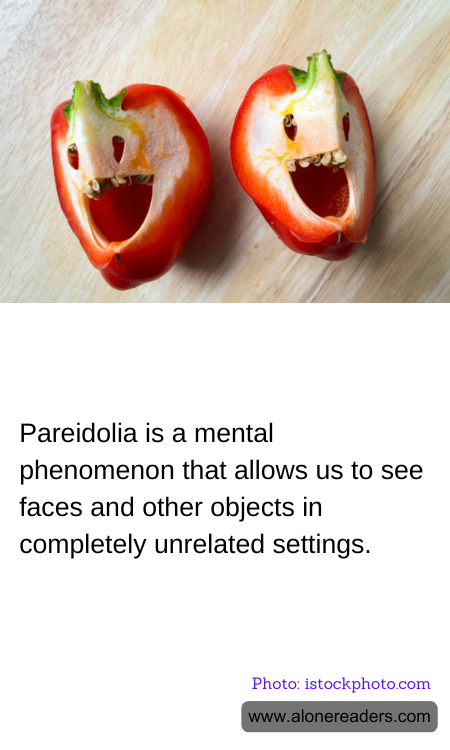
Pareidolia is a psychological phenomenon involving the perception of patterns, particularly faces, in random or ambiguous stimuli. It is a form of apophenia, which is more broadly defined as the tendency to attribute meaning to perceived connections or patterns between unrelated things. Humans are wired to recognize faces, a trait with deep evolutionary roots, essential for social interaction. This facial recognition skill is so finely tuned that it often leads us to see faces in everyday objects—like the front of a car, the arrangement of sockets on an electrical outlet, or formations in clouds.
The phenomenon isn't just limited to visual experiences; it extends to auditory perceptions as well. For example, hearing hidden messages in music or the sound of voices in random noise are forms of auditory pareidolia. This tendency has fascinated and sometimes unnerved people throughout history, influencing both pop culture and more profound spiritual or mythological interpretations. For instance, people might report seeing religious figures in toast or other ordinary items, leading to a blend of mystique and curiosity around the mundane.
Scientists explain pareidolia through several psychological and neuroscientific mechanisms. The human brain is essentially hardwired to recognize and interpret human faces from birth. Even infants only a few hours old prefer looking at something face-like rather than a random pattern. When confronted with ambiguous stimuli, our brain tends to err on the side of caution, opting to see a face, which might explain why this error in recognition tends to go towards the safe side of sensory mistakes.
The significance of pareidolia extends beyond mere curiosity or amusement. In clinical psychology, the frequency and nature of pareidolia can sometimes be a useful diagnostic tool in identifying certain psychiatric or neurological disorders. For example, people with schizophrenia or Parkinson's disease often experience more frequent and pronounced pareidolic illusions.
In the realms of art and creativity, pareidolia has been a tool and an inspiration. Artists and designers have leveraged this innate human tendency to create engaging artworks, illusions, and whimsical inventions that play on our ability to find faces and meaning where none explicitly exist. It challenges viewers' perceptions, encouraging them to question their realities and engage more deeply with the art.
Overall, pareidolia is a fascinating glimpse into the human mind, revealing much about our instincts, fears, and the deep human desire to find order in chaos. Despite being a quirk of perception, it connects deeply to our instinct for pattern recognition, crucial for survival and social interaction throughout human evolution. Whether it sparks amusement, artistic inspiration, or spiritual contemplation, pareidolia illustrates how profoundly our brains are shaped by the need to find familiarity in the unfamiliar.
