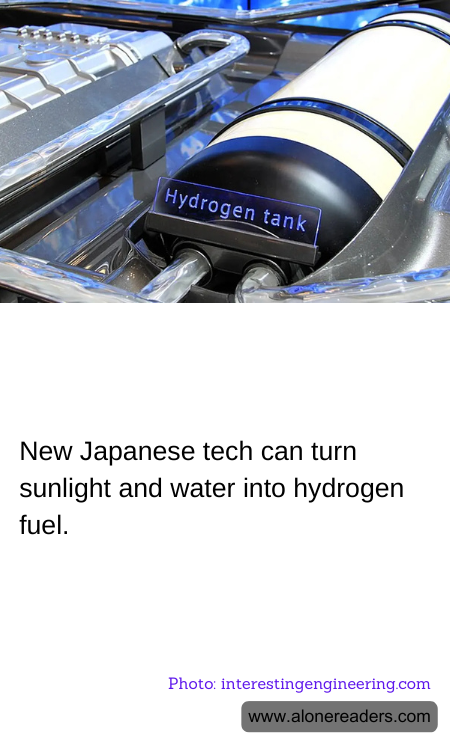
Japan has once again positioned itself at the forefront of alternative energy technologies with its latest breakthrough: a new technology capable of producing hydrogen fuel using only sunlight and water. This innovative approach not only promises a renewable energy source but also offers a potentially transformative solution to global energy and environmental challenges.
Developed by a collaborative team of researchers from several prestigious Japanese institutions, the technology centers around the use of specialized photocatalytic materials that harness sunlight to split water molecules into oxygen and hydrogen. This hydrogen can then be captured and stored as fuel. What makes this technology particularly enticing is its simplicity and efficiency. Unlike traditional methods of hydrogen production, which often require significant energy inputs and produce unwanted carbon emissions, this new method is clean and sustainable, relying solely on abundant natural resources.
The process occurs at room temperature and pressure, further underscoring its potential for widespread application. Researchers have focused on optimizing the photocatalytic materials to enhance their efficiency and durability, overcoming previous hurdles that have hindered the practical deployment of solar-driven water splitting technologies. By tweaking the composition of these materials and enhancing their surface properties, they have managed to significantly increase the production rate of hydrogen.
This breakthrough has substantial implications for the global energy landscape. Hydrogen is a versatile energy carrier with various applications across many sectors such as transportation, industrial processes, and residential heating. Crucially, when burned or used in fuel cells, hydrogen produces only water as a byproduct, offering a stark contrast to the pollutant emissions generated from fossil fuels.
Japan's commitment to fostering a hydrogen economy is well-documented, with the government actively promoting hydrogen as a key pillar of its energy strategy. This new technology aligns with national goals to reduce greenhouse gas emissions and dependence on imported oil and natural gas. There is also significant potential for international collaboration, as countries worldwide strive to meet their energy and environmental targets set under agreements like the Paris Climate Accord.
However, while promising, the technology still faces several challenges before it can be widely adopted. These include improving the cost-effectiveness of the production process and scaling up the technology for industrial use. Additionally, infrastructure for hydrogen storage, transport, and distribution needs further development to fully realize the potential of a hydrogen-based energy system.
As researchers continue to refine this technology and address these challenges, the dream of a sustainable and clean energy future powered by hydrogen moves closer to reality. With continued innovation and support, this new Japanese technology could play a critical role in shaping global energy strategies and combating climate change.
