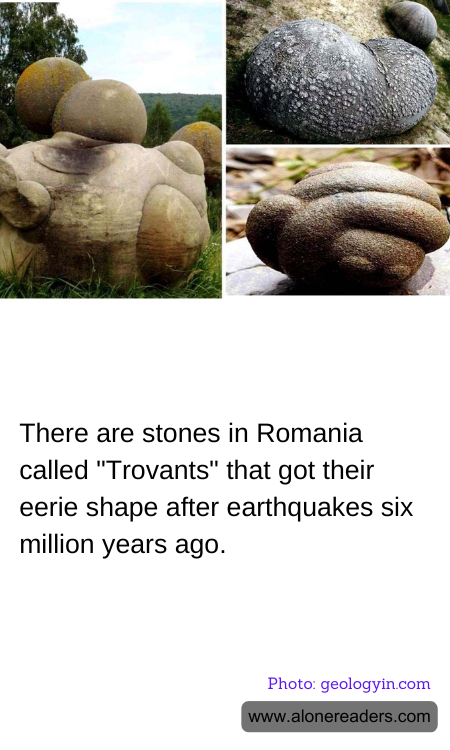
In the intriguing landscapes of Romania, particularly in the region of Costesti, one can discover the unusual geological phenomena known as "Trovants." These remarkable stones are not just ordinary rocks but are known for their peculiar property of seeming to 'grow' like living organisms. The formation of these stones can be traced back to seismic activities that occurred approximately six million years ago, during the Miocene epoch.
Trovants are sedimentary rocks mostly composed of sandstone concretions and embedded mineral salts. What makes them extraordinary is their unique ability to expand and multiply under specific conditions. This has often been credited to the high mineral content in rainfall that permeates the sands around and within the rock, causing a reaction that results in pressure inside the rock. This pressure facilitates a slight expansion and, over an extensive period, forms bulbous lumps and shapes that make each Trovant unique.
Unlike any average rock, the Trovants exhibit ring-like growth patterns similar to tree rings when they are cut through. This aspect suggests that these objects grow similar to how organic matter does, laying down layer upon layer over many years. The sizes of these stones vary significantly, ranging from a few millimeters to several meters in diameter.
The intriguing nature of Trovants has made them a subject of interest not only scientifically but also in terms of tourism. The Trovants Museum Natural Reserve in Costesti, established to protect and promote these geological curiosities, showcases various shapes and sizes, illustrating their growth from tiny pebbles to large boulder formations.
Scientific studies suggest that the field where these Trovants are found was under the ocean millions of years ago. The seismic activities would cause sedimentary deposits to clump together and form these rock formations. Over the ages, as seismic activities declined and water levels receded, these formations were left exposed on the surface. Continued exposure to natural elements contributed further to their growth and peculiar morphology.
Although traditionally not alive, the Trovants of Romania accentuate the fascinating bridge between the inanimate and animate facets of natural history, showcasing how dramatically Earth's geological processes can sculpt our planet's features, impacting ecosystems and human imagination alike. Their 'growth' and 'reproduction' present an exemplary case of how nature can often blur the lines between the living and the non-living, making Trovants a profound emblem of Earth's evolving story.
