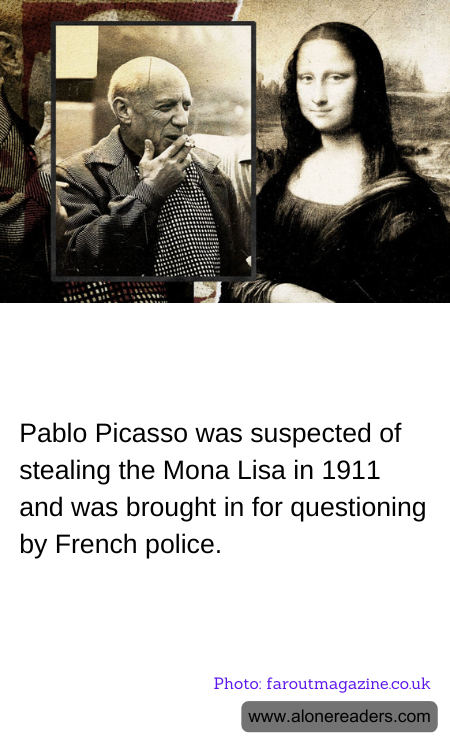
In 1911, the art world was shaken by the audacious theft of Leonardo da Vinci's Mona Lisa from the Louvre Museum in Paris. The mysterious disappearance of the masterpiece captivated the public and led to a wide-ranging investigation. Among the many individuals who were interrogated was none other than the celebrated artist Pablo Picasso. At the time, Picasso was a crucial figure in the avant-garde art scene, already known for his radical approaches to painting which would later culminate in the Cubism movement.
The reason Picasso came under suspicion was largely due to his association with a known art thief, Géry Pieret, who had previously stolen artifacts from the Louvre and sold them. Pieret, a Belgian, was also an occasional secretary and confidante to Picasso's close friend, the poet Guillaume Apollinaire. Apollinaire himself came under suspicion when he tried to rid himself of sculptures that Pieret had earlier pilfered from the museum, fearing that these might implicate him in the ongoing theft inquiry.
Both Apollinaire and Picasso were brought in for questioning by the French police. Apollinaire was actually jailed briefly, and he implicated Picasso during his interrogation. Picasso, when he appeared before the judge, was reportedly so nervous that he denied knowing Apollinaire, despite their close relationship. However, both were eventually exonerated of any involvement in the theft of the Mona Lisa.
The real thief turned out to be Vincenzo Peruggia, an Italian handyman who had worked at the Louvre. He was caught in 1913 after attempting to sell the painting in Italy. It emerged that his motive was a misguided attempt at repatriating what he considered a stolen national treasure to Italy.
The brief but intense scrutiny of figures like Picasso and Apollinaire highlights the often tumultuous intersection of the avant-garde art scene and societal norms of the time. This episode is an interesting footnote in the life of Picasso, illustrating the climate of suspicion that surrounded innovative artists in the early twentieth century. It also emphasizes the unmatched allure and cultural value of the Mona Lisa, a painting that not only inspired artists but also triggered one of the most famous art thefts in history.
