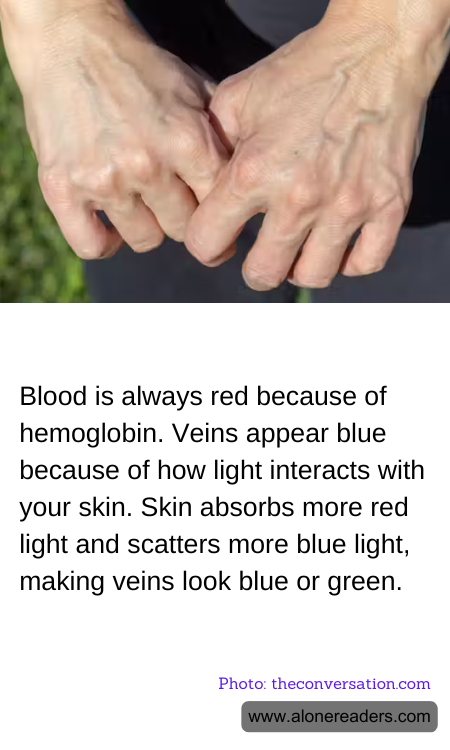
Blood, that vital fluid coursing through our veins, is invariably red, a color imparted by hemoglobin, the protein responsible for transporting oxygen throughout the body. Hemoglobin contains iron, which binds with oxygen and gives blood its distinctive red hue. The intensity of this red color varies depending on the amount of oxygen bound to the hemoglobin; it appears brighter red when saturated with more oxygen and darkens when less is present.
Despite the consistent color of blood, a common misconception is that veins appear blue, when in fact, this is a trick of light and our perception. This optical illusion arises from the way different wavelengths of light penetrate the skin and are absorbed or scattered. Human skin absorbs more red light, which dives deeper beneath the surface, while it scatters blue light, which is shorter in wavelength. As a result, the less-penetrative blue light is reflected back to the eye more than the red light, leading to the appearance of blue or green veins. This scattering effect is known as Rayleigh scattering, the same phenomenon that explains why the sky looks blue on a sunny day.
This understanding of light's interaction with human tissue adds depth to our perception of ourselves and underscores the complexity of our biological structures. Even though it might seem like a simple trick of light, the appearance of blue veins holds underpinnings of sophisticated biological and physical principles, culminating in a seamless perception that belies the intricate realities of human anatomy and optics.
