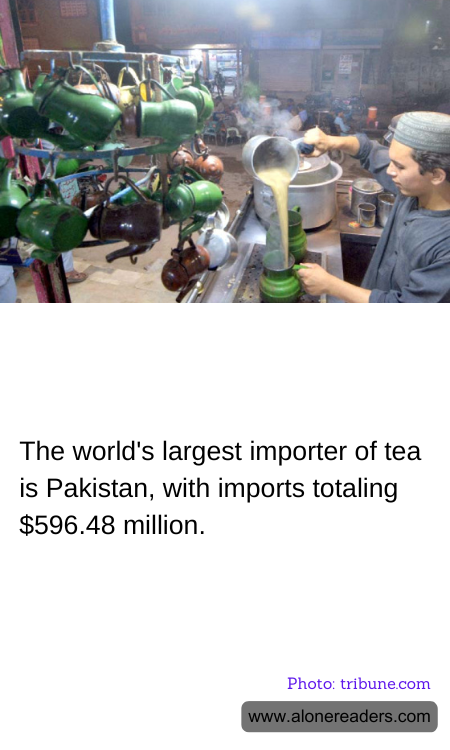
Pakistan stands as the world's largest importer of tea, reflecting not only its high domestic consumption but also the deep cultural significance tea holds in the country. In recent times, Pakistan's tea imports have reached a staggering $596.48 million, underscoring the immense scale and impact of this beverage on the nation's economy and daily life. This significant figure points to a robust demand that has grown steadily over the years, driven by a population that cherishes tea not just as a mere beverage, but as a vital component of social and familial interactions.
The preference for tea in Pakistan spans across all provinces and cultures, with a particular affinity for black tea, which is predominantly imported from countries like Kenya, Sri Lanka, and India. The traditional preparation of tea in Pakistan is rich and varied, often involving boiling black tea leaves with milk and a mix of spices such as cardamom, cinnamon, and cloves—a concoction popularly known as chai. Chai isn't just a drink but an essential part of Pakistani hospitality, served several times a day during meals and whenever guests arrive.
Economic factors play a crucial role as well. With local production of tea being limited due to geographic and climatic constraints, Pakistan relies heavily on imports to satisfy its domestic demand. The high volume of imports can be attributed not only to consumption needs but also to the absence of significant tea cultivation within the country, making it dependent on global markets. This dependence has broader implications, notably in terms of trade balance and foreign currency reserves.
Moreover, the tea import statistic is a reflection of changing lifestyle patterns and economic growth. As disposable incomes in Pakistan rise, tea consumption patterns have evolved, displaying a growing preference for diverse tea varieties, including green and herbal teas, though black tea remains predominant. The increasing urbanization and expansion of cafe culture within metropolitan areas also contribute to a diversified tea market, with more imported teas finding their way into the country.
In summary, the significant figure of $596.48 million in tea imports by Pakistan is more than just a numerical value—it symbolizes a deep-rooted love for tea within the nation while highlighting the challenges and opportunities in balancing domestic consumption with economic realities. As Pakistan continues to be a leading importer, the dynamics of global tea trade remain ever pivotal to its economic and social fabric.
