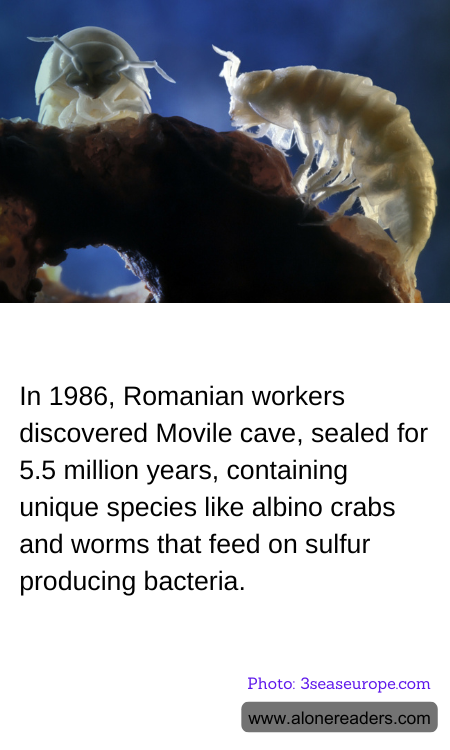
In 1986, a remarkable discovery was made by Romanian workers near the Black Sea town of Mangalia. They stumbled upon the Movile Cave, a subterranean ecosystem that had been sealed off from the outside world for approximately 5.5 million years. The cave's atmosphere is rich in carbon dioxide and sulfuric waters, creating a unique and isolated habitat.
Inside Movile Cave, scientists have identified around 48 species, of which 33 are endemic, meaning they are found nowhere else on Earth. This isolated environment has led to the evolution of some extraordinary creatures, including albino crabs, worms, spiders, and scorpions, all adapted to the dark, oxygen-poor environment of the cave. These species largely depend on a chemosynthetic ecosystem, where bacteria convert carbon dioxide and hydrogen sulfide emitted from the cave's waters into nutrients.
The bacteria form the base of the food chain in the cave, supporting a complex network of organisms. Many of the cave's inhabitants have developed unique adaptations such as enhanced sensory organs or the loss of unnecessary traits, such as pigmentation and eyes, given the perpetual darkness in which they reside. The cave has essentially become a natural laboratory for studying evolution in isolation, offering insights into how life can adapt to some of the most extreme conditions on Earth.
Movile Cave is not only of interest to biologists; the conditions in the cave are akin to those found in extraterrestrial environments, providing astrobiologists with a model for how life might exist on other planets. However, the cave's ecosystem is delicate and remains vulnerable to external influences. Strict regulations are now in place to protect this unique underground world, allowing only a limited number of scientists to enter the cave each year to continue their research and monitor the health of its rare ecosystem. This ensures that Movile Cave continues to serve as a window into Earth's distant past and possibly the future of life exploration beyond our planet.
