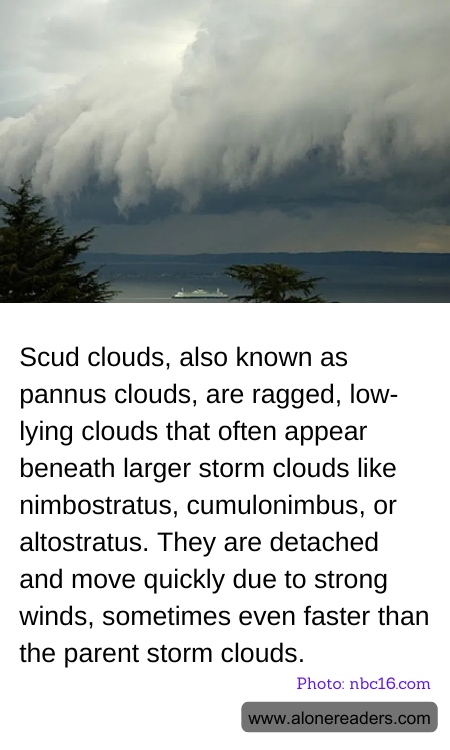
Scud clouds, or pannus clouds, present a dramatic and sometimes ominous appearance in the sky, especially when observed underneath larger storm systems. These clouds are typically ragged and low-lying, and their fragmented nature distinguishes them from the more uniform and cohesive formations of their parent storms, such as nimbostratus or cumulonimbus clouds. Scud clouds are not primary cloud formations but are rather parts of larger clouds that have been shredded by the wind.
Due to their lower altitude, scud clouds often appear to move swiftly across the sky, driven by strong, gusty winds. This rapid movement can sometimes give the false impression that severe weather is imminent; however, while scud clouds are associated with stormy conditions, they do not directly cause severe weather. Instead, their presence usually indicates turbulent air and can be a visual cue to meteorologists and storm spotters that dynamic weather patterns are at play.
Despite their somewhat menacing look, scud clouds are essentially harmless. They can occasionally be mistaken for tornadoes, particularly when viewed from a distance. This is due to their dark color and hanging, tail-like formation, which can mimic the funnel shape of a tornado. However, real tornadoes will show rotational movement, which scud clouds do not possess.
Understanding scud clouds is important, particularly for enthusiasts of severe weather phenomena and professionals in meteorology, because their identification can prevent false tornado warnings and help in accurately assessing the weather situation. Their visual spectacle and rapid movement across the sky also make them a subject of interest among photographers and nature observers, adding a dynamic element to the landscape of storm-watching.
