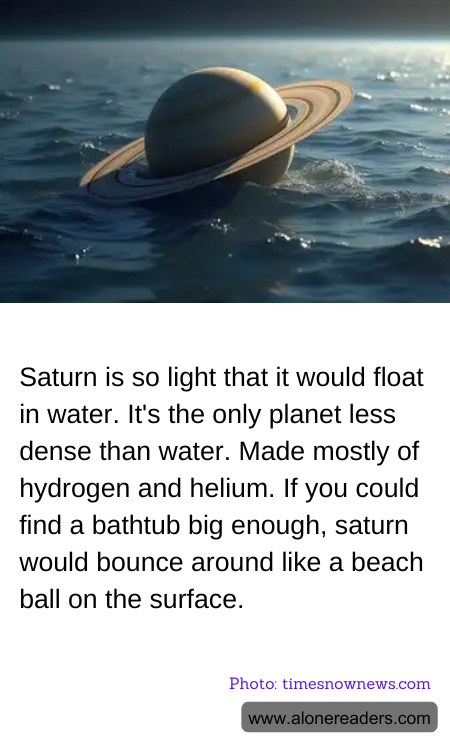
Saturn, the sixth planet from the Sun, is renowned not just for its stunning rings but also for its unique density. Remarkably, Saturn is the only planet in our solar system that is less dense than water, with an average density of about 0.7 grams per cubic centimeter, compared to water's density of 1 gram per cubic centimeter. This means that if there were a bathtub large enough to contain it, Saturn would indeed float. The planet is predominantly composed of hydrogen and helium, which contribute to its low density. These gases make Saturn almost like a giant celestial balloon.
The idea of Saturn bobbing like a beach ball on water is a fascinating visualization of the principles of buoyancy but also underscores the incredible scale and distinct compositions of the celestial bodies in our solar system. Saturn's atmosphere, with its complex layering of gases, and the spectacular ring system made primarily of ice particles, rock debris, and dust, add further intrigue to its character. Its rings, while contributing insignificantly to its mass, would present a dazzling display spreading out across the water’s surface in this imaginary giant bathtub scenario.
Such whimsical imaginings help to communicate the vastness and the diversity of the planetary bodies that share our sun. While we can't literally place Saturn in water, this comparison is a helpful tool in illustrating the sometimes abstract scientific facts about our neighboring planets and their unique traits. This concept not only sparks interest but also imparts a clearer understanding of the physical properties defining objects in our solar system.
