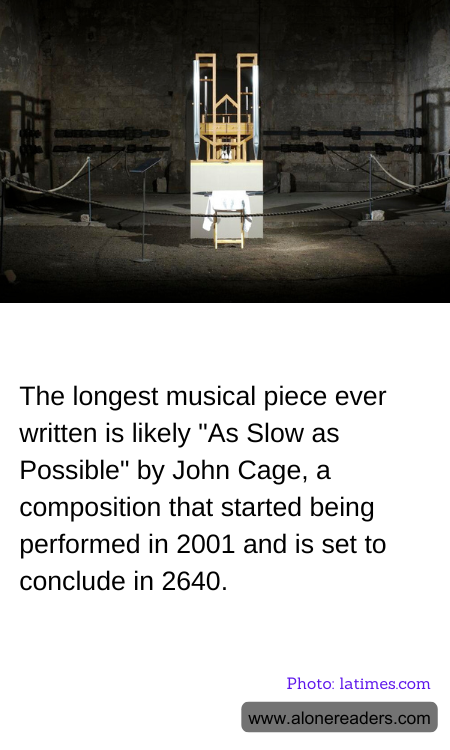
John Cage’s "As Slow as Possible" (ORGAN2/ASLSP) is an extraordinary piece of music not just for its composition, but for its unparalleled duration. Originally written in 1987 for piano, Cage adapted the piece for organ at a later date. The challenge inherent in the piece is to play it as slowly as the performer or venue feasibly can. Taking this invitation to the extreme is the ongoing performance at St. Burchardi church in Halberstadt, Germany, which began in 2001 and is scheduled to end in 2640, thus setting the record for the longest musical performance ever.
This 639-year performance began on Cage's birth anniversary, September 5, 2001—chosen specifically as Halberstadt is historically noted as the place where the first modern keyboard organ was documented to have been built in 1361, 639 years before the start of Cage's performance. The organ built for this event does not have a traditional set of keys and is instead tailored to hold tones for extended periods, with weights resting on the organ’s keys to sustain the note durations.
A significant aspect of the performance’s allure is its invitation to ponder time, sound, and silence. The changes in tone are rare occasions; the most recent note change occurred on September 5, 2020, and each event draws crowds to the church, turning what might be a minor adjustment into a noteworthy spectacle. Between these changes, the organ continues to emit sound, persistently resonating through the church’s ancient arches, creating a living landscape of sound.
Cage, an avant-garde composer renowned for his unconventional approach to sound and silence, as exemplified in his famous piece "4'33"," in which musicians do not play their instruments during the entire duration, deftly manipulates the boundaries and expectations of music with "As Slow as Possible." This performance challenges the listener's perception of time and continuity, making them acutely aware of the moment and the enduring progression of life.
Observers and listeners of "As Slow as Possible" experience a profound engagement with temporality and persistence. This piece is not only a testament to Cage's artistic legacy but also a profound meditation on the human experience of time and the layers of history and sound. As the performance continues to unfold over the centuries, it invites future generations to partake in its contemplative journey, linking past, present, and future in a continuous melody of existential inquiry.
