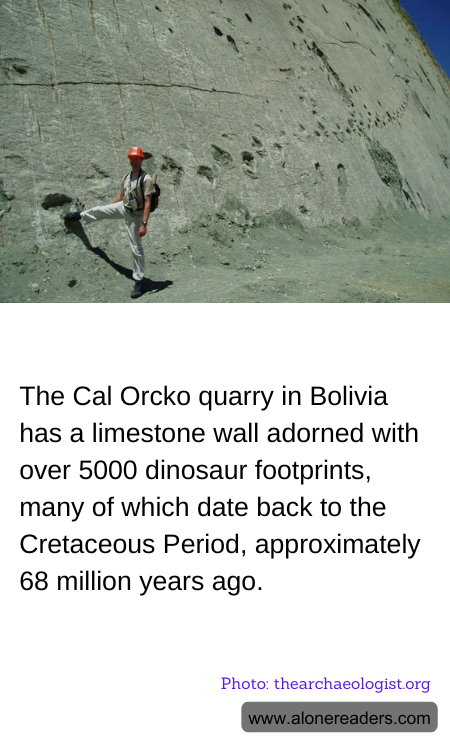
Located near the city of Sucre in Bolivia, the Cal Orcko quarry is home to an extraordinary paleontological site where history is literally imprinted on its walls. This site boasts a staggering collection of over 5,000 dinosaur footprints, preserved on a limestone slab that spans an impressive 1.5 kilometers in length and towers 110 meters high. These ancient traces date back to the late Cretaceous Period, about 68 million years ago, offering a window into a prehistoric era when dinosaurs dominated the land.
The remarkable preservation of these footprints is due, in part, to a sequence of geological events. Originally, the footprints were made in a soft mud on the shores of a lake, which later solidified into limestone. Over millennia, tectonic activity gradually lifted the once-horizontal layers to form a near-vertical wall, exposing the footprints clearly on its surface. This unique positioning not only makes the footprints visible and dramatic but also significantly aids in their study, providing a comprehensive snapshot of dinosaur behaviors and interactions.
The diversity of tracks at Cal Orcko is astounding. The site contains footprints from at least 8 different species of dinosaurs, including large theropods like the fearsome Tyrannosaurus rex, and massive quadrupedal herbivores such as the Titanosaurs. This variety offers paleontologists valuable insights into the ecosystem of the Cretaceous Period, indicating a place teeming with life, where predator and prey interacted in a dynamic environment.
Cal Orcko is more than just a record of individual dinosaurs; it is a rare and invaluable record of the biodiversity of an ancient era and the behaviors of its creatures. The tracks vary in size and depth, suggesting the presence of both juvenile and adult dinosaurs. Some of the paths show straight, purposeful strides, while others display wandering tracks, possibly indicating hunting behavior or social interaction among dinosaur groups.
Given its scientific importance, Cal Orcko has been protected and developed as a tourist and educational site, with the Parque Cretácico (Cretaceous Park) constructed nearby to enhance visitor engagement. This park includes life-sized models of dinosaurs, providing contextual understanding and visual impact for the footprints on display.
The preservation and ongoing study of Cal Orcko contribute vitally to our understanding of the Cretaceous Period's terrestrial ecosystems. As one of the largest and most diverse collections of dinosaur footprints in the world, the site remains a focal point for both scientific research and public interest, bridging millions of years of history with the present day.
