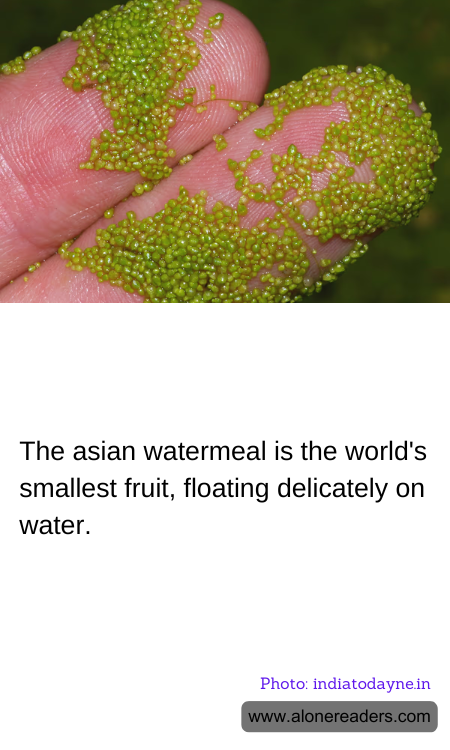
The Asian watermeal, scientifically known as Wolffia globosa, holds the title for the world's smallest fruit. This diminutive plant belongs to the duckweed family and is commonly found in still, fresh bodies of water across Asia and beyond. Each grain of Asian watermeal is barely visible to the naked eye, measuring less than a few millimeters across. Despite their minuscule size, these plants are enormously significant both ecologically and nutritionally.
Floating on the surface of the water, each speck of Asian watermeal is a marvel of efficiency and simplicity. The plant lacks conventional roots, stems, or leaves, relying solely on minuscule fronds that float in a mat-like spread over the water's surface. This form allows it to perform photosynthesis more efficiently than many larger plants, absorbing nutrients and carbon dioxide directly from the water and air.
Ecologically, Wolffia globosa plays a critical role in aquatic ecosystems. Its rapid growth rate allows it to quickly cover vast areas of water, providing a dense canopy that can help manage the ecosystem's temperature and serve as a protective habitat for micro and macro fauna. This coverage also helps reduce the growth of algae blooms by limiting the amount of sunlight that penetrates the water, thus maintaining balanced nutrient levels in freshwater habitats.
Nutritionally, Asian watermeal is a powerhouse in a minuscule package. It is highly nutritious, rich in proteins, and contains essential amino acids, making it a potential sustainable food source. In some Asian cultures, it is already consumed as a vegetable, appreciated for its health benefits including high levels of omega-3 fatty acids, which are beneficial for heart health. The ease of cultivating Wolffia globosa, alongside its nutritional benefits, also makes it an attractive option for space-efficient agricultural practices and a potential candidate for future space missions where growing space and resources are limited.
With ongoing research into its properties and possibilities for use, Asian watermeal continues to be an object of scientific fascination. This diminutive plant may emerge as a critical asset in addressing global nutrition challenges and in developing sustainable agricultural technologies. Through understanding and harnessing its full potential, we could see more widespread adoption of Wolffia globosa in diets and ecosystems around the world, reinforcing the idea that sometimes the smallest things can hold immense potential.
