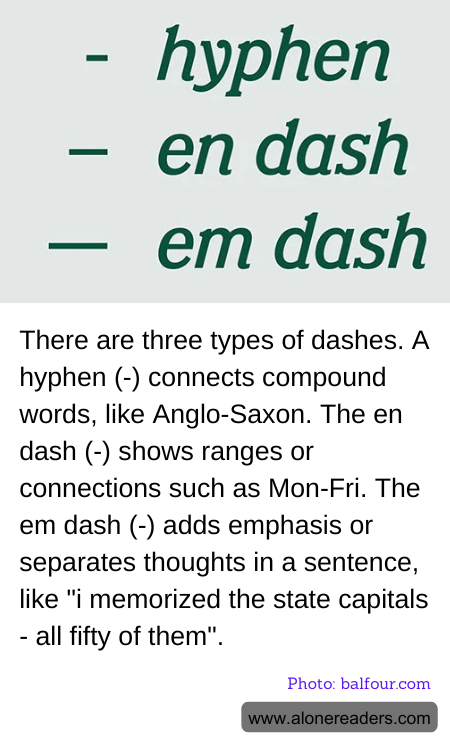
The dash, though seemingly simple, plays versatile roles in English punctuation. The smallest of these is the hyphen (-), commonly used to link words creating compound terms such as "mother-in-law" or "long-term." It's crucial in avoiding ambiguity, like in distinguishing a "small-business owner" from a "small business owner," where the hyphen clarifies the size of the business rather than the proprietor.
Next in line is the en dash (–), slightly wider than the hyphen. It's particularly useful in denoting ranges whether temporal, like Monday–Friday, or numerical, such as pages 10–20. Additionally, the en dash connects places in hyphenated compound adjectives when the elements consist of more than one word, such as a New York–London flight or a Nobel Prize–winning author.
The broadest and perhaps the most dramatic of the trio is the em dash (—). It offers a way to insert a stronger pause than commas or to add a punch of extra emphasis within sentences. It can replace commas, parentheses, or colons to sharpen the focus of a sentence, providing an abrupt break to set aside clarifications or abrupt shifts in thought, like: "She was going to confront him—before her courage failed her."
While they might look similar, the usage rules for hyphens, en dashes, and em dashes are distinct, each serving unique functionalities in writing that help clarify meaning and enhance readability.
