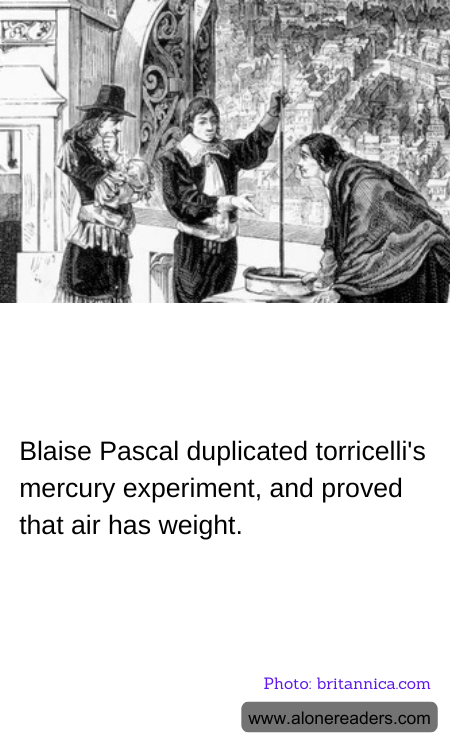
Blaise Pascal, a prominent mathematician, physicist, and philosopher of the 17th century, made significant contributions to our understanding of atmospheric pressure and the nature of air. Among his notable experiments was the replication and extension of Evangelista Torricelli's mercury experiment, which played a crucial role in the development of the barometer.
In the mid-1640s, Torricelli had demonstrated that air pressure could be measured by the height of mercury in a tube, essentially inventing the mercury barometer. This experiment was profound as it showed that air was not a weightless medium, as commonly thought at the time, but rather had weight and exerted pressure. Torricelli's findings suggested that air pressure was responsible for holding the mercury in the tube, a concept that was revolutionary.
Interested in further verifying and expanding upon these findings, Pascal conducted his experiments in 1646. To prove that air pressure was indeed related to the weight of air, Pascal performed what is now famously known as the Puy-de-Dôme experiment. He hypothesized that if air pressure was due to the weight of air, then at higher altitudes, where there is less air above, the pressure should be lower. He sent a barometer up the Puy-de-Dôme mountain in central France and noted that as the altitude increased, the mercury level dropped.
This experiment was crucial because it provided strong evidence that air pressure decreases with altitude, and therefore supported the idea that air has weight. The implications of this were profound, impacting not just the field of physics, but also meteorology, as it led to a better understanding of how atmospheric changes affect weather.
Pascal’s work did more than just prove Torricelli's theories; it expanded the boundaries of human knowledge about the natural world. His experiment underscored the importance of empirical evidence in science, and his innovative approach to testing and proving hypotheses laid foundational principles for scientific methods. Additionally, by linking the barometric pressure changes to the elevation, Pascal inadvertently paved the way for further exploration in both earth sciences and atmospheric studies, illustrating once again how curiosity and critical thinking can lead to significant advancements in our understanding of the world.
