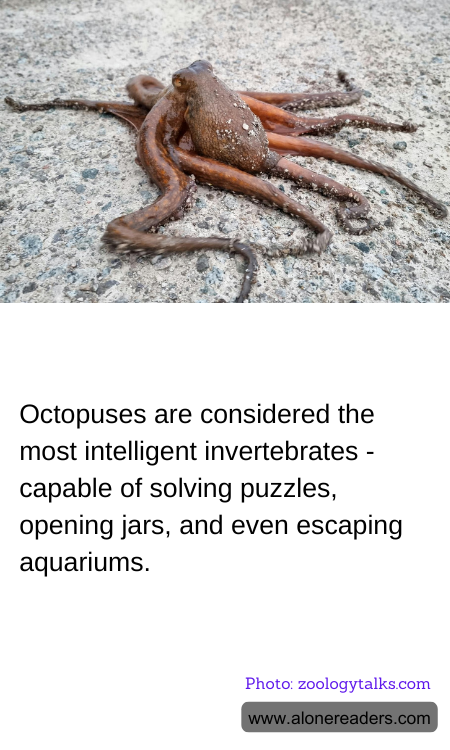
Octopuses are indeed fascinating creatures, renowned for their exceptional intelligence among invertebrates. Their cognitive abilities allow them to engage in complex behaviors that are rare in the animal kingdom. One of the most striking demonstrations of their intellect is their ability to solve puzzles. Researchers have observed octopuses navigating mazes and differentiating between various shapes and patterns. Such tasks require a level of cognitive function that includes both short-term and long-term memory.
Moreover, octopuses have shown they can manipulate their environment in extraordinary ways, exemplified by their capacity to open jars. This ability involves not only understanding the mechanism of screw-top jars but also coordinating their flexible, suction-cupped arms to do so. This remarkable skill is not just about physical prowess but also involves problem-solving, which is indicative of a sophisticated understanding of their surroundings and the objects they interact with.
Another testament to their intelligence is their noted escapology. Octopuses in captivity have been known to escape from their enclosures, which sometimes involve lifting heavy tank lids or maneuvering through small openings. These escape attempts sometimes even include exiting the water to travel across adjacent surfaces, which demonstrates not only spatial awareness and planning but also an understanding of their physical environment that rivals that of much larger and more neuron-rich animals.
The intelligence of octopuses is believed to be partly due to their large brains relative to their body size, alongside a high number of neurons located in their arms. These neurons allow them to bypass their central brain, enabling the arms to act independently and learn from the environment, enhancing their ability to interact and manipulate objects.
This unique blend of skills is further augmented by their ability to use camouflage and mimicry not just for predation and defense but also as a method of communication. An octopus can rapidly alter its skin color and texture to blend into environments or send signals to other creatures, showcasing an adaptive edge built on keen observational skills and split-second physiological adjustments.
Their extraordinary talents hint at a complex level of consciousness and a sophisticated nervous system that challenges our human-centric views of intelligence and problem-solving. This understanding pushes scientists and animal behaviorists to rethink the cognitive landscapes of non-mammalian creatures and how we assess the intelligence across different species in the animal kingdom.
