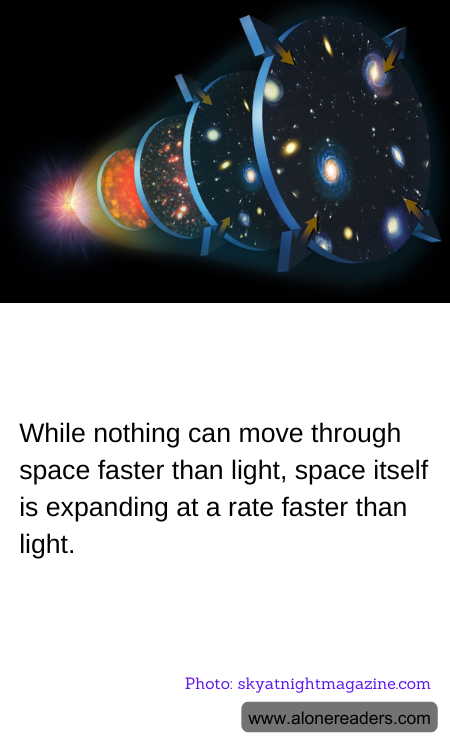
The concept of the speed limit of light, capped at approximately 299,792 kilometers per second in a vacuum, is a fundamental principle of the universe as described by Einstein’s theory of relativity. This speed limit, however, applies to objects moving through space, not to the expansion of space itself. What confounds ordinary intuition is that while we can't travel through space faster than the speed of light, the fabric of space can expand at any speed, potentially faster than light.
The universe has been expanding since its inception with the Big Bang, about 13.8 billion years ago. This expansion is not like the movement of cars on a highway but is rather the stretching of space itself. This means that galaxies are not traveling through space away from each other but are being carried along as space itself expands. This effect is most noticeable at vast cosmic scales.
In regions of the universe far beyond our local group of galaxies, space can expand at a rate that exceeds the speed of light. This does not violate Einstein’s speed limit because technically, nothing is moving through space faster than light. Instead, space itself is growing, increasing the distance between objects. Due to this rapid expansion, light from distant galaxies may never reach us because the space between us and those galaxies is stretching out so quickly.
This phenomenon is described by the metric expansion of space, where the metric—a measure of distance that includes the stretch of space itself—changes over time. Cosmologists quantify this expansion with the Hubble constant, which is a measure of how fast the universe expands relative to distance. Observations, such as those from the Hubble Space Telescope and other instruments, allow astronomers to estimate the rate of expansion and observe its effects across the observable universe.
The discovery that the universe could be expanding faster than light has profound implications for our understanding of the cosmos, including the ultimate fate of the universe. It also leads to observable phenomena such as the cosmological redshift, where light from an object is stretched to longer, redder wavelengths as it travels through expanding space.
In summary, while nothing can travel through space faster than light due to relativity constraints, the space between objects in the universe can expand so quickly that it effectively recedes at a rate faster than the speed of light. This is a fundamental aspect of our understanding of the cosmos and shapes everything from the future of the universe to the types of astronomical observations that can be made.
