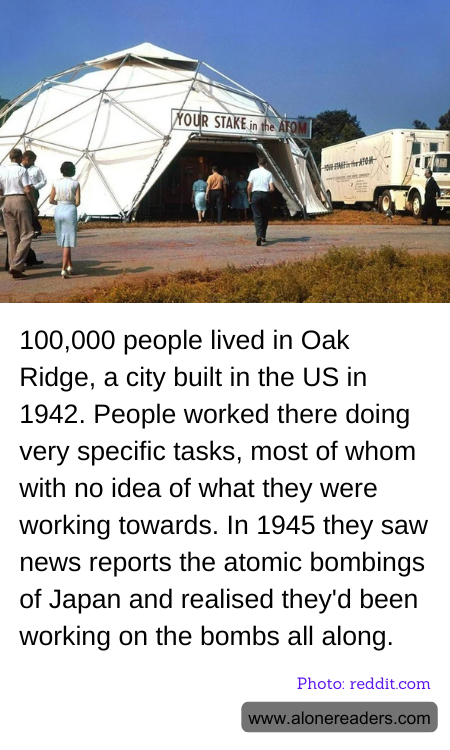
In 1942, amidst the secrecy and urgency of World War II, the United States government embarked on an ambitious and classified project known as the Manhattan Project. The goal was to develop the atomic bomb before the Axis powers could achieve a similar breakthrough. As part of this massive undertaking, the government created an entirely new city called Oak Ridge in the remote ridges of Tennessee. This city, codenamed "Site X," was one of three primary sites responsible for the research and development required to construct the atomic bomb.
Oak Ridge was designed from the ground up to support this top-secret project, with no expense spared to construct the required facilities and infrastructure. Remarkably, the city's population ballooned to over 100,000 people by the end of the war, becoming the fifth-largest city in Tennessee almost overnight. However, the majority of these workers knew little about the specifics or the ultimate goal of their daily tasks. Employed in various capacities, from janitorial staff to machine operators or scientists, residents carried out their duties under a thick veil of secrecy, with information strictly compartmentalized.
Life in Oak Ridge was unique and heavily restricted. The town was fenced, and guarded, and movement in and out was tightly controlled. Information was censored, and any discussions about work outside of designated areas were forbidden. Workers lived in a mix of hastily constructed houses, dormitories, and trailers. Despite these conditions—or perhaps because of them—the community also thrived in its own way, with schools, churches, and even a symphony orchestra.
It wasn't until August 6, 1945, when the atomic bomb "Little Boy" was dropped on Hiroshima, followed three days later by the detonation of "Fat Man" over Nagasaki, that the workers at Oak Ridge realized the full scope and significance of their labor. The news that their efforts had contributed to creating a weapon of unprecedented power brought a mix of pride, astonishment, and horror.
The realization was particularly profound because many of those who worked at Oak Ridge were not military personnel or career scientists, but rather ordinary Americans from various walks of life who had taken on these jobs to contribute to the war effort. The reactions ranged from justified patriotism to introspection about the morality of the atomic bombings and the future implications of nuclear weapons.
Today, Oak Ridge is recognized for its role in ending World War II and as a pivotal site in the history of nuclear energy and research. The city continues to operate at the forefront of scientific innovation, driven by institutions like the Oak Ridge National Laboratory. Its legacy, however, remains deeply intertwined with the complex ethical and moral questions surrounding nuclear weapons and energy, reflecting a poignant chapter in the story of human technological achievement and its consequences.
