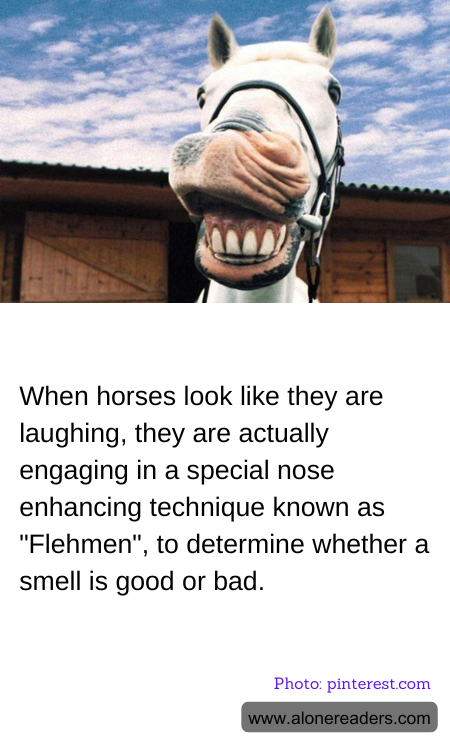
When horses draw back their lips and curl their upper lip, exposing their teeth in what appears to be a laugh or a grimace, they are actually performing a behavior known as the "Flehmen response". This peculiar action is a fascinating aspect of equine behavior that is also seen in other mammals, including some big cats and farm animals. The primary purpose of this response is not to express amusement or disdain, but to enhance the animal's sense of smell.
The Flehmen response helps horses and other animals with a vomeronasal organ (also called Jacobson’s organ) to analyze scents more effectively. When a horse curls its lips and raises its head, it allows pheromones and other scent particles to enter a specialized duct that leads to the vomeronasal organ, located above the roof of the mouth. This organ is highly sensitive to chemical stimuli and plays a crucial role in social and reproductive behaviors.
By performing the Flehmen response, a horse can detect the presence of certain scent markers, such as those indicating the reproductive status of a potential mate. It is often seen in stallions checking if a mare is in estrus, but mares and young horses also exhibit this behavior when encountering unfamiliar scents. The action enables the animal to draw the scent deeper into the Jacobson's organ where the scent can be examined in greater detail, helping the horse determine whether the smell is good, bad, or significant in some other way.
This behavior is not just limited to reproductive contexts but can be triggered by a variety of intriguing or strong odors. For example, horses might display the Flehmen response when they encounter new smells in their environment, such as unfamiliar food, urine marks from other animals, or unusual organic materials. This indicates that the Flehmen response is a critical component of a horse's investigative behavior, allowing them to interact more deeply with their environment and make more informed decisions based on their sophisticated sense of smell.
In conclusion, the Flehmen response in horses is a unique physiological adaptation that augments their olfactory capabilities, allowing for better interpretation of complex scents. What might initially seem like a humorous expression is thus a sophisticated sensory tool that plays an important role in their interactions with other animals and their surroundings. It is a striking example of how animal behaviors, although sometimes odd in appearance, can reveal intricate biological processes.
