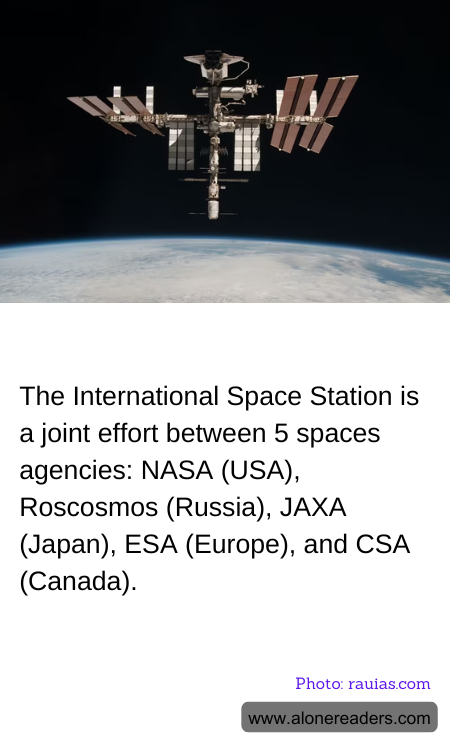
The International Space Station (ISS) stands as a testament to international collaboration and the pursuit of scientific knowledge and exploration. Operated by not one but five different space agencies - NASA from the United States, Roscosmos from Russia, JAXA from Japan, ESA representing various European nations, and CSA from Canada - the ISS serves as a microgravity and space environment research laboratory. These agencies collaborate closely to ensure the effective functioning and utilization of this unique research platform that orbits the Earth.
Launched into orbit in 1998, the ISS has been continuously inhabited since November 2000. The space station travels at an average altitude of approximately 420 kilometers above Earth and orbits our planet about 16 times a day. Its microgravity environment allows scientists, researchers, and astronauts to conduct experiments across multiple disciplines, including biology, human biology, physics, astronomy, and meteorology, that would be impossible to perform on Earth.
The research conducted on the ISS has led to numerous advances in science and technology. Studies on the human body's reaction to prolonged space exposure, for instance, have been crucial for planning longer space missions, possibly to Mars and beyond. Experiments in fluid dynamics, materials science, and combustion have also yielded fascinating results, providing insights that influence both space-related and terrestrial applications. Moreover, the station acts as a base for the deployment of satellites, a number of which are student-designed, thus inspiring future generations in the field of space technology.
Beyond its scientific and educational roles, the International Space Station also serves as a powerful symbol of international cooperation. Amid fluctuating geopolitical climates, it demonstrates how countries can set aside differences and work together towards common scientific goals that potentially benefit all humanity. This cooperation not only helps smooth over technological and financial challenges by pooling resources and expertise but also fosters a shared sense of purpose and understanding among the nations involved.
As the ISS ages, the participating space agencies continually discuss and plan its future. While private companies might play a greater role, the legacy of the ISS will likely influence future multilateral space endeavors. Its existence proves that with international cooperation, the boundaries of what humanity can achieve are significantly broader - a principle that will be vital as humans reach further into the cosmos.
