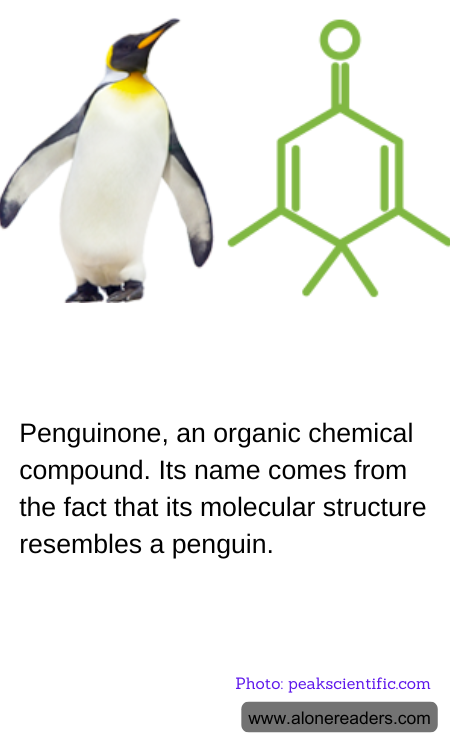
More About This Card
Penguinone is a fascinating organic chemical compound, notable not just for its unique properties but also for its whimsical name which is derived from its molecular resemblance to a penguin. This compound, with the chemical formula C10H14O, features a ketone group and a distinctive arrangement of carbon atoms that collectively mimic the shape of a penguin, complete with what appears to be a head, body, and feet. The molecular structure and nomenclature of penguinone make it a memorable point of study in organic chemistry, showcasing the lighter side of scientific naming conventions.
Discovered and first synthesized by British chemist A.J. Birch in 1963, penguinone primarily serves as a subject of academic interest rather than having significant commercial applications. Its synthesis involves standard organic reactions, using readily available starting materials, making it accessible for study in university laboratories. Chemists find it valuable for teaching purposes, as it provides an engaging example of how real-world molecules can occasionally mimic everyday objects, even something as unexpected as a penguin. Moreover, the study of penguinone can aid students in understanding the complex arrangements and geometric configurations possible in organic molecules.
Although penguinone does not have prominent applications in industrial or pharmaceutical fields, its study is crucial for educational and theoretical advancements in organic chemistry. It acts as a gateway for students and scientists to explore the diversity of molecular structures and to appreciate the intersection of nature and science at the molecular level. Additionally, each such unique compound helps to expand the catalog of known organic compounds, contributing to the overall knowledge pool and occasionally leading to serendipitous discoveries in synthesis and application in various fields of chemistry. Thus, while penguinone might not be as ubiquitous or essential as other organic compounds, its role in the educational and theoretical landscape of chemistry remains undeniably significant.