More About This Card
In the annals of history, few figures stand as tall as Mansa Musa, the 14th-century ruler of the Mali Empire in West Africa. Renowned for his immense wealth and generosity, Mansa Musa is often cited as the richest person to have ever lived. His legendary pilgrimage to Mecca in 1324 not only showcased his vast riches but also left an indelible mark on the regions he traversed.
Mansa Musa ascended to the throne in 1312, inheriting a kingdom that was already prosperous due to its abundant natural resources, particularly gold. Under his reign, the Mali Empire expanded significantly, encompassing present-day Mali, Senegal, Gambia, Guinea, Niger, Nigeria, Chad, and Mauritania. This expansion further solidified Mali's position as a major player in the trans-Saharan trade routes, which were the lifeblood of commerce between Africa and the Mediterranean world.
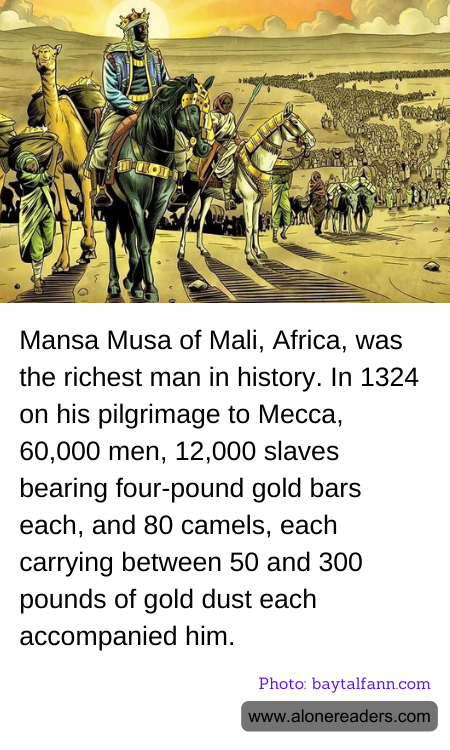
The most famous episode of Mansa Musa's reign was his pilgrimage to Mecca, a journey that was as much a demonstration of faith as it was a display of wealth. Accompanied by a retinue of 60,000 men, including 12,000 slaves each carrying four-pound gold bars, and 80 camels laden with between 50 and 300 pounds of gold dust each, the caravan was a spectacle of opulence. This grand procession not only underscored Mansa Musa's devotion to Islam but also served as a powerful statement of his empire's prosperity.
As the caravan moved through the Sahara Desert and into the cities of Cairo, Medina, and finally Mecca, Mansa Musa's generosity became legendary. He distributed gold to the poor, built mosques, and funded schools, inadvertently causing a temporary economic upheaval in regions like Cairo, where the sudden influx of gold devalued the metal for years. This act of munificence not only enhanced his reputation but also put the Mali Empire on the map, attracting scholars, architects, and traders from across the Islamic world.
Mansa Musa's pilgrimage had far-reaching effects beyond the immediate economic impact. It established Mali as a center of learning and culture, with Timbuktu becoming a renowned hub for education and Islamic scholarship. The construction of the Djinguereber Mosque and the establishment of the University of Sankore are testaments to the intellectual and cultural legacy that Mansa Musa left behind.
In the centuries since his reign, Mansa Musa's story has become a symbol of Africa's rich history and its contributions to the world. His life and legacy remind us of the continent's historical wealth and influence, challenging modern perceptions and inspiring a reevaluation of Africa's place in global history. Mansa Musa's journey to Mecca was more than a religious pilgrimage; it was a transformative event that highlighted the grandeur of the Mali Empire and the enduring impact of its most illustrious ruler.