More About This Card
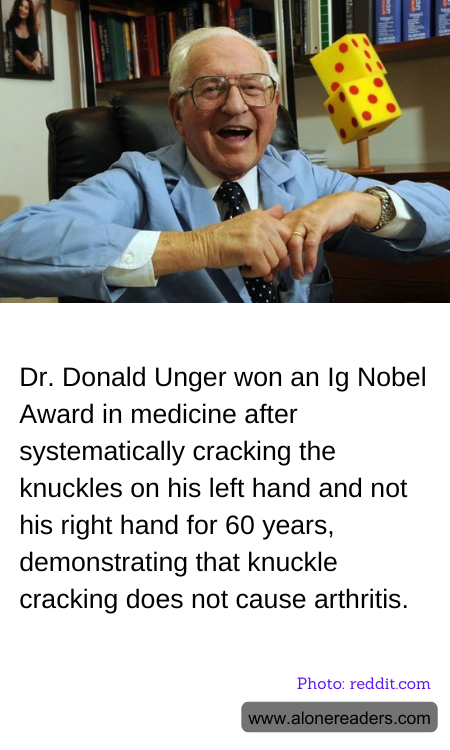
In the world of scientific exploration, where groundbreaking discoveries often dominate the headlines, there are also those curious experiments that capture the imagination with their simplicity and humor. One such experiment was conducted by Dr. Donald Unger, a California-based physician, who embarked on a personal journey to investigate a common belief: that cracking knuckles leads to arthritis. His dedication to this peculiar inquiry earned him the Ig Nobel Prize in Medicine in 2009, a lighthearted award that honors achievements that first make people laugh, and then make them think.
Dr. Unger's experiment began as a child, spurred by his mother's warnings that cracking knuckles would lead to arthritis. Intrigued and perhaps a bit skeptical, he decided to put this claim to the test in a way that only a true scientist would. For 60 years, Dr. Unger systematically cracked the knuckles on his left hand at least twice a day, while leaving his right hand untouched. This long-term commitment to his self-imposed study was driven by a desire to provide a definitive answer to a question that had puzzled many.
After six decades of diligent knuckle cracking, Dr. Unger found no difference in the incidence of arthritis between his two hands. His left hand, subjected to years of habitual cracking, showed no signs of arthritis, nor did his right hand, which had been spared the ritual. This personal experiment provided compelling evidence against the widely held belief that knuckle cracking is a direct cause of arthritis. Dr. Unger's findings were not only a testament to his perseverance but also a reminder of the importance of questioning assumptions and testing them through scientific inquiry.
The Ig Nobel Prize, awarded to Dr. Unger, celebrates the spirit of curiosity and the pursuit of knowledge, even in the most unconventional ways. His work highlights the value of long-term observation and the role of personal experimentation in debunking myths. While the Ig Nobel Prizes often spotlight research that is humorous or seemingly trivial, they also underscore the broader message that science is not just about grand discoveries but also about exploring everyday questions with rigor and creativity.
Dr. Unger's experiment serves as a delightful reminder that science can be both serious and playful. It encourages us to look at the world with a critical eye and to challenge the status quo, even if it means embarking on a decades-long journey of knuckle cracking. His story is a testament to the power of curiosity and the joy of discovery, no matter how small or seemingly insignificant the question may be. In the end, Dr. Unger's work not only cracked a myth but also opened the door to a deeper appreciation for the scientific method and the endless possibilities it offers.