More About This Card
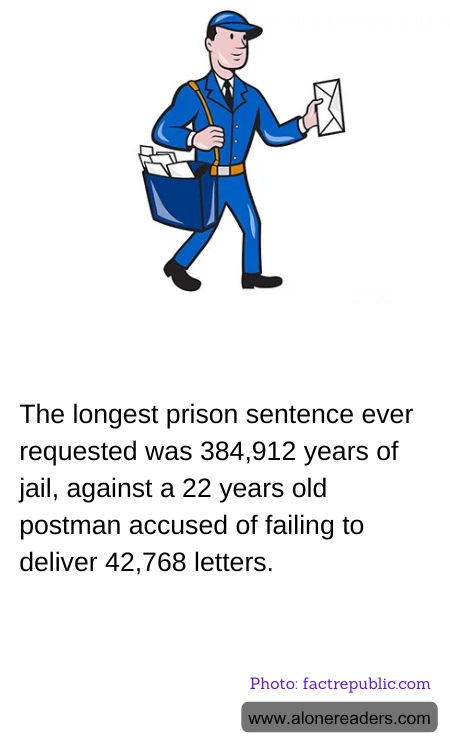
In the annals of legal history, there are cases that stand out not just for their peculiarities but for the sheer scale of the penalties sought. One such case involved a 22-year-old postman in Spain, who found himself at the center of a legal storm when prosecutors requested a staggering 384,912-year prison sentence. This unprecedented request was made after the postman was accused of failing to deliver 42,768 letters, a breach of duty that sparked both legal and public interest.
The young postman, whose identity was kept confidential, was charged with a serious breach of trust. His alleged failure to deliver thousands of letters was not just a violation of his professional duties but also a disruption to the lives of countless individuals who depended on the postal service for communication. The letters, which were discovered in his home, ranged from personal correspondence to official documents, some of which could have had significant implications for the recipients.
The enormity of the requested sentence was based on the Spanish legal system's approach to calculating penalties. Each undelivered letter was considered a separate offense, and the potential sentence for each was compounded, resulting in the astronomical figure. While the request was largely symbolic, intended to underscore the severity of the crime, it highlighted the complexities and sometimes the absurdities of legal systems when dealing with mass offenses.
This case sparked widespread debate about the proportionality of punishment and the role of the justice system in addressing breaches of public trust. Critics argued that such an extreme sentence was not only impractical but also highlighted the need for reform in how penalties are calculated for cumulative offenses. The case also raised questions about the pressures faced by postal workers and the systemic issues within postal services that might lead to such breaches.
While the requested sentence was never likely to be imposed in full, it served as a stark reminder of the importance of accountability and the potential consequences of neglecting professional responsibilities. It also underscored the need for a balanced approach to justice, one that considers both the severity of the crime and the broader context in which it occurred.
In the end, the case of the young postman became a cautionary tale, illustrating the potential for legal systems to become entangled in their own complexities. It also served as a reminder of the critical role that postal services play in society and the trust that is placed in those who deliver our letters and packages. As the world continues to evolve, with digital communication increasingly replacing traditional mail, the lessons from this case remain relevant, emphasizing the need for integrity and accountability in all forms of communication.