More About This Card
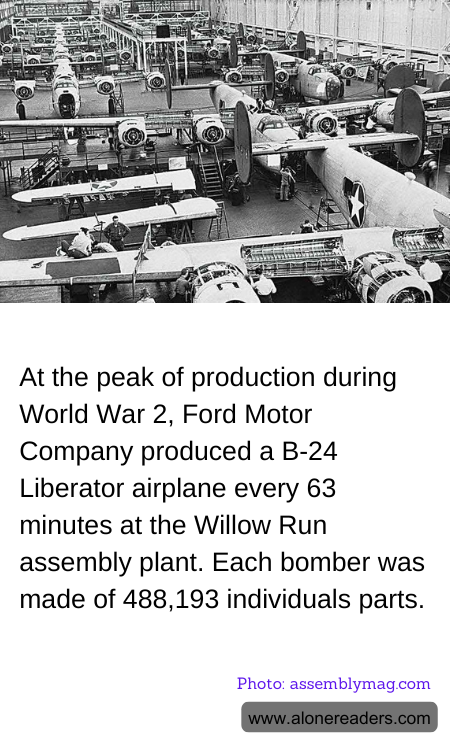
During World War II, the Ford Motor Company achieved a remarkable feat of industrial engineering and production efficiency that played a crucial role in the Allied war effort. At the Willow Run assembly plant in Michigan, Ford managed to produce a B-24 Liberator bomber every 63 minutes, a testament to American ingenuity and the power of mass production. This extraordinary accomplishment not only highlights the company's adaptability but also underscores the critical importance of manufacturing in wartime.
The B-24 Liberator was a heavy bomber used extensively by the United States and Allied forces. Known for its long range and high payload capacity, the B-24 was a vital asset in the strategic bombing campaigns that targeted enemy infrastructure and supply lines. Each bomber was composed of an astounding 488,193 individual parts, a complexity that required meticulous coordination and precision in manufacturing. Ford's ability to streamline the production of such a complex machine was nothing short of revolutionary.
The Willow Run plant, often referred to as the "Arsenal of Democracy," was a sprawling facility specifically designed to accommodate the mass production of aircraft. Under the leadership of Henry Ford and his team, the plant employed innovative assembly line techniques that had been honed in the automotive industry. These methods were adapted and scaled up to meet the demands of aircraft production, allowing for unprecedented speed and efficiency. The plant's operation was a collaborative effort involving thousands of workers, including many women who entered the workforce for the first time, symbolizing a significant shift in societal roles during the war.
The impact of Willow Run's production capabilities was profound. By the end of the war, the plant had produced over 8,600 B-24 bombers, significantly contributing to the Allied forces' ability to maintain air superiority. This production capacity not only provided the necessary equipment for military operations but also demonstrated the potential of American industry to meet and exceed the challenges posed by global conflict.
Ford's achievement at Willow Run is a powerful example of how industry and innovation can be harnessed to meet the needs of a nation in crisis. The legacy of this period is reflected in the continued emphasis on efficiency and technological advancement in manufacturing. Today, the story of Willow Run serves as an inspiring reminder of what can be accomplished when determination, ingenuity, and collaboration come together in pursuit of a common goal.