More About This Card
In the heart of Jerusalem, a city revered by multiple faiths, lies the Church of the Holy Sepulchre, a site of profound religious significance. This ancient church, believed to be the location of Jesus Christ's crucifixion, burial, and resurrection, is a focal point for Christian pilgrims worldwide. Yet, beyond its spiritual importance, the church is also a symbol of a unique and delicate balance known as the "Status Quo."
The Status Quo is an understanding that governs nine shared religious sites in Jerusalem and Bethlehem, including the Church of the Holy Sepulchre. Established in the 18th century, this arrangement was formalized in 1852 by the Ottoman Empire to maintain peace among the various Christian denominations that lay claim to these sacred spaces. The agreement delineates the rights and responsibilities of the Greek Orthodox, Armenian Apostolic, Roman Catholic, Coptic Orthodox, Ethiopian Orthodox, and Syriac Orthodox churches, ensuring that each has access to and control over specific parts of the church.
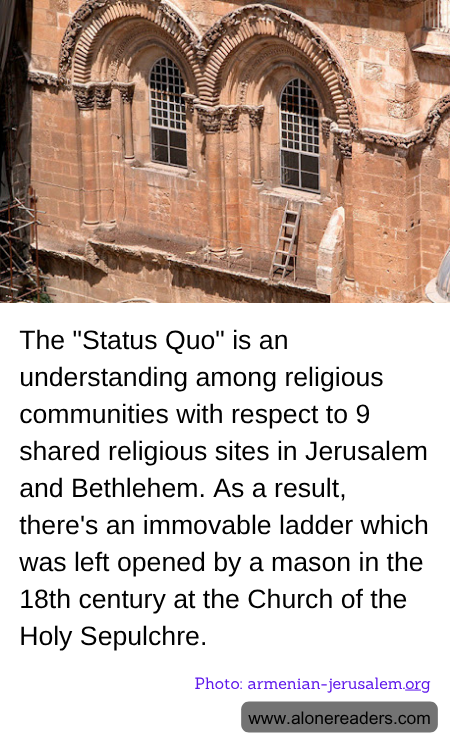
One of the most intriguing manifestations of the Status Quo is the presence of an immovable ladder at the Church of the Holy Sepulchre. This wooden ladder, resting on a ledge above the church's entrance, has remained in place for centuries. According to tradition, it was left there by a mason in the 18th century. The ladder's immobility is not due to its physical weight but rather to the symbolic weight it carries. Moving it would require the consensus of all the communities involved, a task that has proven to be diplomatically challenging over the years.
The ladder serves as a poignant reminder of the complexities and sensitivities involved in maintaining peace among the diverse religious communities in Jerusalem. It stands as a testament to the enduring nature of the Status Quo, which, despite its challenges, has successfully preserved a fragile harmony in one of the world's most contested and sacred spaces. The ladder's presence is a silent witness to the intricate dance of diplomacy and faith that characterizes the management of these shared holy sites.
For visitors to the Church of the Holy Sepulchre, the ladder is more than just an oddity; it is a symbol of the delicate balance that allows people of different faiths to coexist in a place of profound spiritual significance. It underscores the importance of dialogue, respect, and understanding in a world where religious and cultural differences often lead to conflict. The immovable ladder, in its quiet way, invites reflection on the power of cooperation and the enduring quest for peace in a city that holds deep meaning for so many.