More About This Card
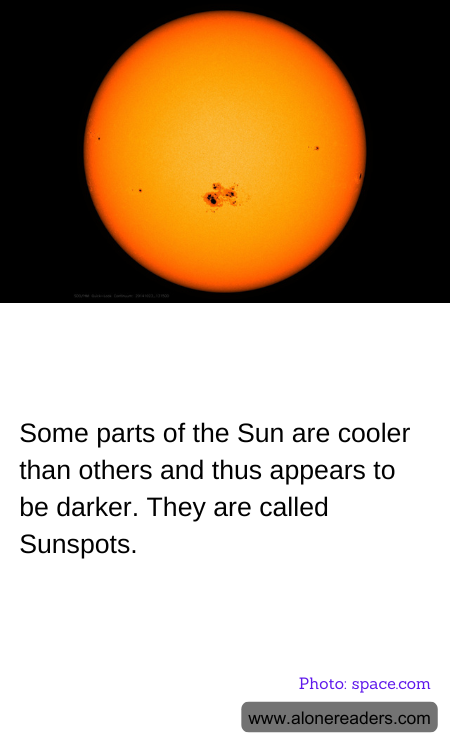
The Sun, our closest star, is a massive ball of hot plasma that illuminates our world and sustains life on Earth. While it may appear as a uniformly bright and fiery sphere from a distance, the Sun's surface is far from homogenous. Among its many fascinating features are sunspots, which are areas that appear darker than their surroundings. These intriguing phenomena have captivated astronomers and scientists for centuries, offering insights into the dynamic nature of our star.
Sunspots are temporary phenomena on the Sun's photosphere, the visible surface layer, and are characterized by their relatively cooler temperatures compared to the surrounding areas. While the average temperature of the Sun's surface is about 5,500 degrees Celsius (9,932 degrees Fahrenheit), sunspots can be significantly cooler, with temperatures dropping to around 3,500 degrees Celsius (6,332 degrees Fahrenheit). This temperature difference is what causes sunspots to appear darker, as cooler regions emit less light.
The formation of sunspots is closely linked to the Sun's magnetic field. The Sun is a giant magnet, with its magnetic field lines looping out into space and back again. Sunspots occur when these magnetic field lines become twisted and concentrated, inhibiting the flow of hot plasma from the Sun's interior to its surface. This magnetic activity not only cools the affected area but also creates intense magnetic fields that can be thousands of times stronger than Earth's magnetic field.
Sunspots are not just isolated dark patches; they often appear in groups and can vary in size, with some being large enough to be visible from Earth without a telescope. These spots can last from a few days to several months, depending on the stability of the magnetic fields that create them. The number of sunspots on the Sun's surface fluctuates over an approximately 11-year cycle known as the solar cycle. During periods of high solar activity, known as solar maximum, sunspots are more numerous, while during solar minimum, they are scarce.
The study of sunspots is not merely an academic pursuit; it has practical implications for our planet. Sunspots are often associated with solar flares and coronal mass ejections, which are powerful bursts of energy and charged particles that can impact space weather. These solar events can disrupt satellite communications, affect power grids, and pose risks to astronauts in space. By monitoring sunspots, scientists can better predict and prepare for these solar activities, helping to mitigate their potential impact on modern technology and infrastructure.
In conclusion, sunspots are a testament to the Sun's complex and dynamic nature. Though they appear as dark blemishes on the Sun's surface, they are a window into the powerful magnetic forces at play within our star. Understanding sunspots not only enriches our knowledge of the Sun but also helps us anticipate and adapt to the challenges posed by its ever-changing behavior.