More About This Card
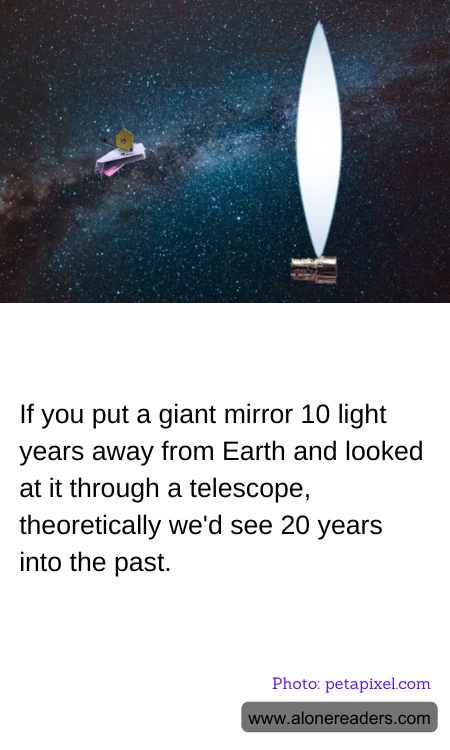
Imagine a colossal mirror floating in the vastness of space, positioned precisely 10 light years away from Earth. This hypothetical scenario, while seemingly plucked from the pages of a science fiction novel, offers a fascinating glimpse into the nature of light and time. If we were to peer into this distant mirror through a powerful telescope, we would, in theory, witness a reflection of Earth as it was 20 years ago. This intriguing concept hinges on the fundamental properties of light and the vast distances it travels across the universe.
Light, the fastest entity in the universe, travels at an astonishing speed of approximately 299,792 kilometers per second. When we observe celestial bodies, we are essentially looking back in time because the light from these objects takes years, sometimes even millions of years, to reach us. In our mirror scenario, light from Earth would take 10 years to reach the mirror. Upon reflection, it would take another 10 years for that light to travel back to Earth. Thus, the image we would see in the mirror would be a 20-year-old snapshot of our planet.
This thought experiment underscores the concept of light years, a unit of astronomical distance that represents how far light travels in one year. It also highlights the fascinating relationship between space and time, a cornerstone of Einstein's theory of relativity. According to relativity, the speed of light is constant, and as such, the further away an object is, the older the light we see from it. This is why astronomers often say they are looking back in time when they observe distant galaxies.
While the idea of a giant mirror in space is purely theoretical, it serves as a captivating illustration of how light behaves over astronomical distances. It also sparks curiosity about the universe and our place within it. The concept encourages us to ponder the vastness of space and the intricate dance of light and time that allows us to glimpse the universe's history.
In practical terms, constructing such a mirror is beyond our current technological capabilities. However, the exercise of imagining it helps us appreciate the marvels of modern astronomy, where telescopes like the Hubble Space Telescope allow us to peer deep into the cosmos, observing light that has traveled for billions of years. These observations not only enrich our understanding of the universe but also remind us of the incredible journey that light undertakes to bring us images from the past.
In essence, the idea of a giant mirror 10 light years away is a testament to the wonders of physics and the boundless curiosity that drives scientific exploration. It invites us to reflect on the nature of reality and the profound connection between time, light, and space, encouraging a deeper appreciation for the universe's mysteries.