More About This Card
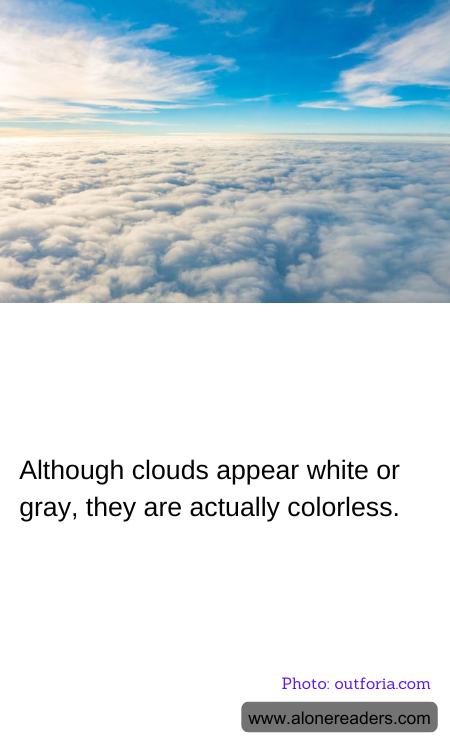
Clouds are a fascinating and ever-present part of our natural world, often capturing our imagination with their majestic formations and shifting hues. While they frequently appear white or gray to the human eye, the truth is that clouds are actually colorless. This intriguing phenomenon can be explained through the science of light and the unique properties of water droplets and ice crystals that make up clouds.
When we gaze up at the sky, the clouds we see are composed of countless tiny water droplets or ice crystals suspended in the atmosphere. These particles are inherently colorless, but they interact with sunlight in ways that create the colors we perceive. Sunlight, which appears white, is actually made up of a spectrum of colors, each with different wavelengths. When sunlight encounters the water droplets in clouds, it is scattered in all directions. This scattering process affects the different wavelengths of light in varying degrees, depending on the size of the droplets.
In clouds with smaller droplets, the scattering is more uniform across all wavelengths, which results in the light being reflected back to our eyes as white. This is why clouds often appear bright and white, especially when the sun is shining directly on them. However, as clouds become thicker and denser, they can block more sunlight, causing less light to be scattered and reflected. This reduction in light can make clouds appear gray or even dark, particularly when viewed from below.
The color of clouds can also change with the position of the sun. During sunrise or sunset, the sun's rays pass through a greater thickness of the Earth's atmosphere, which scatters shorter wavelengths of light, such as blue and green, more than longer wavelengths, like red and orange. This scattering effect can give clouds a warm, colorful glow during these times of day, even though the clouds themselves remain colorless.
Understanding the true nature of clouds as colorless entities helps us appreciate the complex interplay of light and atmosphere that creates the beautiful and varied skies we observe. It also serves as a reminder of the wonders of the natural world and the scientific principles that govern it. Whether they appear as fluffy white cotton balls or ominous gray blankets, clouds continue to captivate people of all ages, inspiring curiosity and wonder about the world above us.