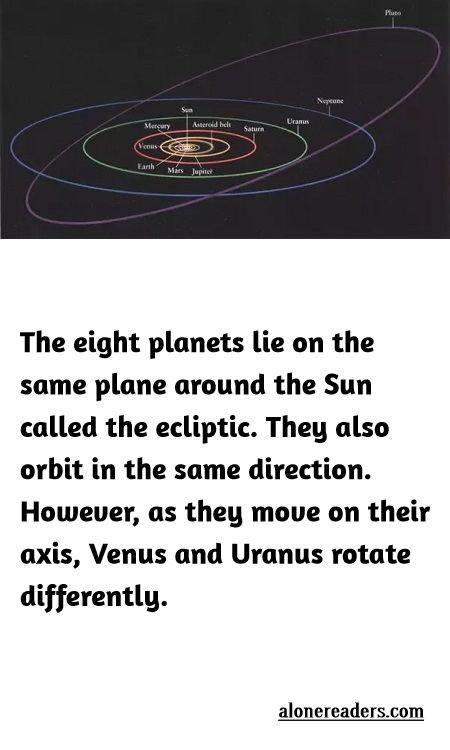
The architecture of our Solar System is a marvel of planetary alignment and orbital mechanics. All eight planets orbit the Sun on a relatively flat plane known as the ecliptic plane. This alignment is no accident but a consequence of how our Solar System formed over 4.5 billion years ago from a spinning disc of gas and dust. As the solar nebula collapsed under gravity, it began to spin faster and flatten into a disc, the plane of which defines the ecliptic.
Remarkably, not only do the planets coexist on this common plane, but they also share a uniform direction of orbit around the Sun—counterclockwise when viewed from above the North Pole. This directional harmony is again a relic of their shared origin from the same rotating disc, which imparted angular momentum to all the bodies formed within it, steering them in a collective orbital dance around the Sun.
However, there are intriguing exceptions to these orderly motions when considering how planets rotate on their axes. Most planets, including Earth, rotate in the same direction they orbit, with their poles tilted only slightly. Venus and Uranus are marked exceptions, revealing some of the dynamic celestial drama that has played out across eons.
Venus, intriguingly, spins very slowly on its axis and in the opposite direction to most planets, a phenomenon known as retrograde rotation. It takes Venus longer to complete one rotation on its axis than it does to complete one orbit around the Sun. This bizarre spin suggests a violent history, possibly involving collisions with other celestial bodies that drastically altered its rotational direction.
Uranus presents another peculiar case. It has an extreme axial tilt, lying sideways at an angle of about 98 degrees relative to its orbit. This unique tilt causes Uranus to appear as if it is rolling along its orbit around the Sun. The consensus among astronomers is that Uranus likely experienced a cataclysmic event, where it was hit by one or possibly more massive objects, tipping it dramatically.
These rotational anomalies provide vital clues to the violent past of our seemingly orderly Solar System, illustrating that the current calmness is a stark contrast to its possible turbulent beginnings. Understanding why Venus and Uranus rotate differently from the rest of the planets not only highlights the complexities of planetary dynamics but also serves as a reminder of the chaotic processes that contribute to the formation and evolution of planetary systems.
