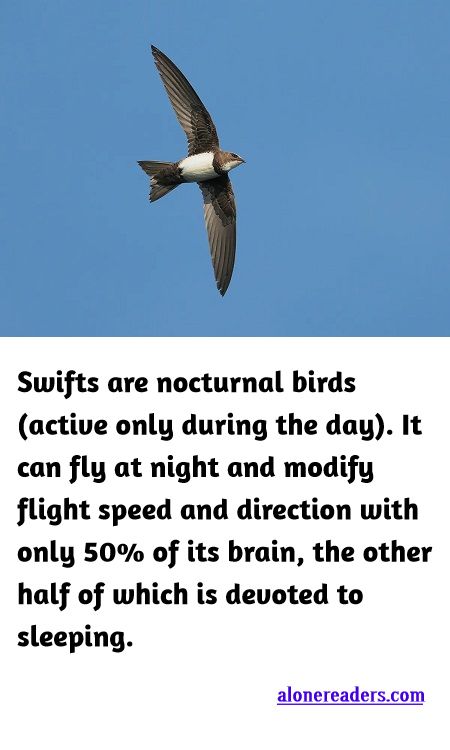
Swifts are fascinating birds, known for their impressive aerial abilities and unique adaptations to flight. Contrary to the notion that they are nocturnal, swifts are actually diurnal, or active during the day. They spend most of their lives in the air, feeding, mating, and even sleeping while flying. This extraordinary ability to remain airborne is aided by their exceptionally long wings and lightweight bodies, which allow for almost effortless flight.
One of the most remarkable aspects of swifts is their ability to sleep while flying. This phenomenon is known as "unihemispheric slow-wave sleep," where one half of the brain sleeps while the other half remains alert. This adaptation is crucial for their survival as it enables them to remain vigilant to potential predators and navigate through their environment even while resting. Studies using electroencephalographic (EEG) recordings have shown that swifts can indeed have one hemisphere of their brain exhibit sleep-like patterns while the other remains awake, a trait shared with some aquatic mammals and birds that need to be continuously on the move.
Swifts are also capable of incredible speeds, particularly noted during their swift dives during courtship displays or when catching their insect prey mid-air. Their flight muscles are highly efficient, and their streamlined bodies reduce drag, allowing swifts to reach high speeds and change directions rapidly. The control they exhibit over their flight with such precision, while only using half their brain capacity for navigation, underscores their unique neurological and physiological adaptations.
The adaptability of swifts extends to their annual migration patterns, where they embark on long journeys covering thousands of kilometers. During these migrations, swifts demonstrate an incredible endurance, flying across continents and seas without stopping. Their migratory paths are a further testament to their robust navigation skills, whether maneuvering through varying weather conditions or locating specific nesting sites upon their return.
In conclusion, swifts are a group of birds whose entire lifestyle revolves around their flight capabilities. From sleeping in the air to consuming thousands of insects every day while in flight, their life in the skies is a testament to the remarkable evolutionary developments they have undergone. The unique half-brained sleep mechanism they employ not only aids in their survival but also highlights the complexity and adaptability of the avian world. As creatures that spend most of their lives airborne, swifts truly epitomize what it means to be free as a bird.
