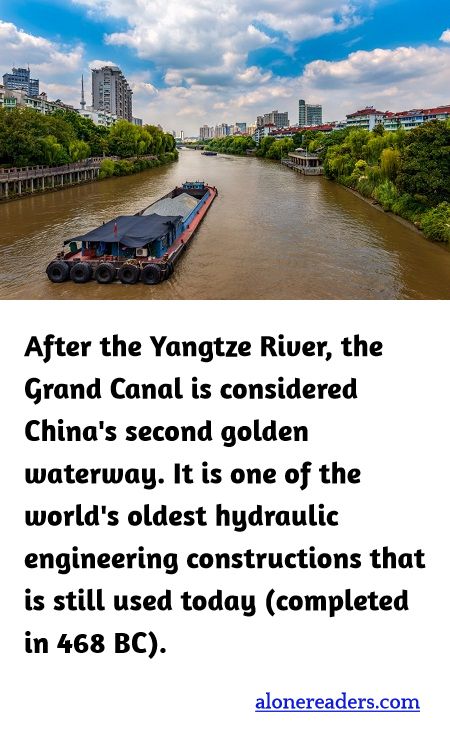
The Grand Canal of China, a marvel of ancient engineering, stands as a testament to the ingenuity and vision of the Chinese civilization. Completed in 468 BC, this vast waterway was primarily built to connect the rich northern territories with the fertile southern lands, facilitating not just the transportation of surplus grain to the north but also serving as a major avenue for internal trade and communication. Over centuries, it fostered economic growth and integration within the diverse regions of China, playing a crucial role in the country’s development.
Running over 1,100 miles from Beijing in the north to Hangzhou in the south, the Grand Canal surpasses the Suez and Panama Canals in both age and length, making it one of the greatest hydraulic projects of the ancient world. The canal was constructed in different sections over various dynasties, with major expansions and renovations occurring during the Sui, Yuan, Ming, and Qing dynasties. It linked five of the major river systems in China, including the Yellow River and the Yangtze River.
Today, the Grand Canal is not only a historical relic but also a vibrant lifeline that supports shipping and tourism. Sections of the canal have been modernized to accommodate larger vessels, while other parts retain their historic charm and are popular with tourists. The ancient water towns, stone bridges, traditional temples, and lush landscapes along the canal offer a glimpse into China’s past intertwined with modernity.
The Grand Canal was designated a UNESCO World Heritage site in 2014, an acknowledgment of its historical significance and contribution to Chinese culture. It continues to be a symbol of the strategic importance of waterways in the socioeconomic development of a civilization and remains a source of inspiration for modern hydraulic engineering projects around the world. Its enduring legacy is a reminder of the lasting impact that thoughtful infrastructure projects can have on the prosperity and unity of a nation.
